Question
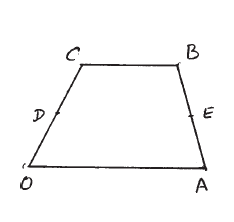
Using vectors prove that the line segment joining the mid-points of non-parallel sides of a trapezium is parallel to the base and is equal to half the sum of the parallel sides.
Answer

Let $\overrightarrow{a}, \overrightarrow{b} \text{and}\overrightarrow{c}$ be the position vectors of A, B and C respectively w.r.t. O. Let D and E be the mid-points of parallel sides OC and AB respectively.

$\therefore \text{Position vector of}$

$\text{D is} \frac{O +\overrightarrow{C}}{2} = \frac{\overrightarrow{c}}{2}$

$CB\parallel OA \Rightarrow \overrightarrow{a}\parallel \overrightarrow{b} - \overrightarrow{c}$

$\Rightarrow \text{E is parallel to base and its length is half the sum of lengths of the parallel sides.}$

Need a full question paper?

Generate a complete, print-ready paper with questions like this in minutes — across 16+ boards, with answer keys.

Start Generating Free

Similar questions

Find the points o local maxima or local minima, if any, of the following functions, using the first derivatives test. Also, find the local maximum or local minimum values, as the case may be:
f(x) = x3 - 3x
If $\vec{\text{a}},\vec{\text{b}},\vec{\text{c}}$ are three unit vectors such that $\vec{\text{a}}\times\vec{\text{b}}=\vec{\text{c}},\vec{\text{b}}\times\vec{\text{c}}=\vec{\text{a}},\vec{\text{c}}\times\vec{\text{a}}=\vec{\text{b}}.$Show that $\vec{\text{a}},\vec{\text{b}},\vec{\text{c}}$ from an orthonormal right handed triad of unit vectors.
Find $\big[\vec{\text{a}}\ \vec{\text{b}}\ \vec{\text{c}}\big]$, when
$\vec{\text{a}}=2\hat{\text{i}}-3\hat{\text{j}},\vec{\text{b}}=\hat{\text{i}}+\hat{\text{j}}-\hat{\text{k}}$ and $\vec{\text{c}}=3\hat{\text{i}}-\hat{\text{k}}$
Find the integrals of the functions in Exercises:
$\tan^4\text{x}$
Show that the logarithmic function $\text{f}:\text{R}0^+\rightarrow \text{R}$ given by f(x) = loga x, a > 0 is a bijection.
Find the intervals in which f(x) is increasing or decreasing:
$\text{f}(\text{x})=\text{x}|\text{x}|,\text{x}\in\text{R}$
Evaluate $\triangle=\begin{vmatrix}0&\sin\alpha&-\cos\alpha\\-\sin\alpha&0&\sin\beta\\\cos\alpha&-\sin\beta&0 \end{vmatrix}$
$\begin{array}{l}\text { Verify } A(\text { adj. A) }=(\operatorname{adj} . A) A=|A| \text { : } \\ {\left[\begin{array}{ccc}1 & -1 & 2 \\ 3 & 0 & -2 \\ 1 & 0 & 3\end{array}\right]}\end{array}$
Given a non empty set X, consider P(X) which is the set of all subsets of X.

Define the relation R in P(X) as follows:

For subsets A, B in P(X), ARB if and only if $\text{A}\subset\text{B}.$ Is R an equivalence relation on P(X)? Justify your answer.


$\text{If} \ \vec{a}=2\hat{i}+2\hat{j}+3\hat{k},\ \ \vec{b}=-$ $\hat{i}+2\hat{j}+\hat{k}\ \text{and}\ \vec{c}=3\hat{i}+\hat{j}$ are such that $\vec{a}+\lambda\vec{b}$ is perpendicular to $\vec{c},$ then find the value of $\lambda.$