Question
Using vectors, prove that the parallelogram on the same base and between the same parallels are equal in area.
Answer

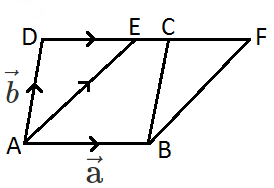
Let ABCD and ABFE are parallelograms on the same base AB and between the same parallel line AB and DF.

Let $\overrightarrow{\text{AB}}=\vec{\text{a}}$ and $\overrightarrow{\text{AD}}=\vec{\text{b}}$
$\therefore$ Area of parallelogram $\overrightarrow{\text{ABCD}}=\vec{\text{a}}\times\vec{\text{b}}$
Now, area of parallelogram of $\overrightarrow{\text{ABFE}}=\overrightarrow{\text{AB}}\times\overrightarrow{\text{AE}}$
$=\overrightarrow{\text{AB}}\times(\overrightarrow{\text{AD}}+\overrightarrow{\text{DE}})$
$=\overrightarrow{\text{AB}}\times(\vec{\text{b}}+\text{k}\vec{\text{a}})$ $[\text{let}\overrightarrow{\text{ DE}}=\text{k}\vec{\text{a}},\text{where k is a scalar}]$ 
$=\vec{\text{a}}\times(\vec{\text{b}}+\text{k}\vec{\text{a}})$
$=(\vec{\text{a}}\times\vec{\text{b}})+(\vec{\text{a}}\times\text{k}\vec{\text{a}})$
$=(\vec{\text{a}}\times\vec{\text{b}})+\text{k}(\vec{\text{a}}\times\vec{\text{a}})$
$=(\vec{\text{a}}\times\vec{\text{b}})\ [\because\vec{\text{a}}\times\vec{\text{a}}=0]$
Area of parallelogram ABCD.
Hence proved.

Need a full question paper?

Generate a complete, print-ready paper with questions like this in minutes — across 16+ boards, with answer keys.
Start Generating Free

Similar questions

Find the equation of the plane through the line of intersection of the planes x + y + z = 1 and 2x + 3y + 4z = 5 and twice of its y-intercept is equal to three times its z-intercept.
If $x^x + y^x = 1,$ prove that $\frac{\text{dy}}{\text{dx}}=-\frac{\text{y}(\text{y}+\text{x}\log\text{y})}{\text{x}(\text{y}\log\text{x}+\text{x})}$
Evaluate the following integrals:
$\int\limits^{5}_0\frac{\sqrt[4]{\text{x}+4}}{\sqrt[4]{\text{x}+4}+\sqrt[9]{9-\text{x}}}\text{ dx}$
Verify Rolle's theorem of the following function on the indicated interval
$\text{f}(\text{x})=\sin^4\text{x}+\cos^4\text{x}\text{ on }\Big[0,\frac{\pi}{2}\Big]$
Prove by vector method that the sum of the squares of the diagonals of a parallelogram is equal to the sum squares of its sides.
Prove that the line through A(0, –1, –1) and B(4, 5, 1) intersects the line through C(3, 9, 4) and D(–4, 4, 4).
Differentiate $\sin^{-1}\Big(4\text{x}\sqrt{1-4\text{x}^2}\Big)$ with respect to $\sqrt{1-4\text{x}^2},$ if:
$\text{x}\in\Big(-\frac{1}{2\sqrt{2}},\frac{1}{2}\Big)$
Find the largest possible area of a right angled triangle whose hypotenuse is 5cm long.
Find the points of discontinuity, if any of the following function:
$\text{f(x)}=\begin{cases}|\text{x}|+3,&\text{if }\text{ x}\geq-3\\-2\text{x},&\text{if }-3<\text{ x}<3\\6\text{x}+2,&\text{if }\text{ x}>3\end{cases}$
A manufacturer produces three types of bolts, $x, y$ and $z$ which he sells in two markets. Annual sales $($in $₹)$ are indicated below:
Markets Products
$X$ $Y$ $Z$
$I$ $10000$ $2000$ $18000$
$II$ $6000$ $20000$ $8000$
If unit sales prices of $x, y$ and z are $₹\ 2.50, ₹\ 1.50$ and $₹\ 1.00$ respectively, then answer the following questions using the concept of matrices.
  1. Find the total revenue collected from the Market$-I.$
  1. $₹\ 44000$
  2. $₹\ 48000$
  3. $₹\ 46000$
  4. $₹\ 53000$
  1. Find the total revenue collected from the Market$-II.$
  1. $₹\ 51000$
  2. $₹\ 53000$
  3. $₹\ 46000$
  4. $₹\ 49000$
  1. If the unit costs of the above three commodities are $₹\ 2.00, ₹\ 1.00$ and $50$ paise respectively, then find the gross profit from both the markets.
  1. $₹\ 53000$
  2. $₹\ 46000$
  3. $₹\ 34000$
  4. $₹\ 32000$
  1. If matrix $\text{A}=[\text{a}_\text{ij}]_{2\times2},$ where $\text{a}_\text{ij}=1,$ if $\text{i}\neq\text{j}$ and $\text{a}_\text{ij}=0,$ if $\text{i}=\text{j}$ then $A^2$ is equal to:
  1. $I$
  2. $A$
  3. $OR$
  4. None of these
  1. If $A$ and $B$ are matrices of same order, then $(AB' - BA')$ is a.
  1. Skew$-$synunetric matrix.
  2. Null matrix.
  3. Symmetric matrix.
  4. Unit matrix.