Question
Using vectors, prove that the parallelogram on the same base and between the same parallels are equal in area.
Answer

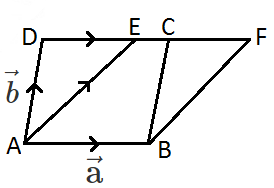
Let ABCD and ABFE are parallelograms on the same base AB and between the same parallel line AB and DF.

Let $\overrightarrow{\text{AB}}=\vec{\text{a}}$ and $\overrightarrow{\text{AD}}=\vec{\text{b}}$
$\therefore$ Area of parallelogram $\overrightarrow{\text{ABCD}}=\vec{\text{a}}\times\vec{\text{b}}$
Now, area of parallelogram of $\overrightarrow{\text{ABFE}}=\overrightarrow{\text{AB}}\times\overrightarrow{\text{AE}}$
$=\overrightarrow{\text{AB}}\times(\overrightarrow{\text{AD}}+\overrightarrow{\text{DE}})$
$=\overrightarrow{\text{AB}}\times(\vec{\text{b}}+\text{k}\vec{\text{a}})$ $[\text{let}\overrightarrow{\text{ DE}}=\text{k}\vec{\text{a}},\text{where k is a scalar}]$ 
$=\vec{\text{a}}\times(\vec{\text{b}}+\text{k}\vec{\text{a}})$
$=(\vec{\text{a}}\times\vec{\text{b}})+(\vec{\text{a}}\times\text{k}\vec{\text{a}})$
$=(\vec{\text{a}}\times\vec{\text{b}})+\text{k}(\vec{\text{a}}\times\vec{\text{a}})$
$=(\vec{\text{a}}\times\vec{\text{b}})\ [\because\vec{\text{a}}\times\vec{\text{a}}=0]$
Area of parallelogram ABCD.
Hence proved.

Need a full question paper?

Generate a complete, print-ready paper with questions like this in minutes — across 16+ boards, with answer keys.

Start Generating Free

Similar questions

Using vectors, find the area of the triangle with vertices:
  1. A(1, 1, 2), B(2, 3, 5) and C(1, 5, 5)
  2. A(1, 2, 3), B(2, -1, 4) and C(4,5, -1)
Solve the following differential equation:
$\text{xy}\log\Big(\frac{\text{y}}{\text{x}}\Big)\text{dx}+\Big\{\text{y}^2-\text{x}^2\log\Big(\frac{\text{y}}{\text{x}}\Big)\Big\}\text{dy}=0$
A curve is such that the length of the perpendicular from the origin on the tangent at any point P of the curve is equal to the abscissa of P. Prove that the differential equation of the curve is $\text{y}^{2}-2\text{xy}\frac{\text{dy}}{\text{dx}}-\text{x}^{2}=0$ and hence find the curve.
Discuss the continuity of the following functions at the indicated point:
$\text{f}\text{(x)}=\begin{cases}|\text{x}-\text{a|}\sin(\frac{1}{\text{x}-\text{a}}), &\text{for} \text{ x} \neq\text{a}\\0,&\text{for} \text{ x} = \text{a}\end{cases}\text{ at x}=0$
Solve the following differential equation
$(1+\text{x}^2)\text{dy}=\text{xy dx}$
Differential equation $\frac{\text{d}^2\text{y}}{\text{dx}^2}+\text{y}=0,\text{y}(0)=1,\text{y}'(0)=1$

Function $\text{y}=\sin\text{x}+\cos\text{x}$

For the matrix $\text{A} = \begin{bmatrix}3&2\\1&1\end{bmatrix},$ find the numbers a and b such that A2 + aA + bI = 0.

Show the solution zone of the following inequalities on a graph paper:

$\text{x}+\text{y}\leq50$

$3\text{x}+\text{y}\geq90$

$\text{x},\text{y}\geq0$

Find $\frac{\text{dy}}{\text{dx}}$
$\text{y}=\text{x}^{\cos\text{x}}+(\sin\text{x})^{\tan\text{x}}$
Find the solution of $\frac{\text{dy}}{\text{dx}}=2^\text{y-x}.$