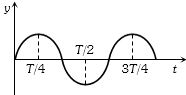
Values of the acceleration $A$ of a particle moving in simple harmonic motion as a function of its displacement $x$ are given in the table below. The period of the motion is
| $A (mm \,\,s^{-2}$) |
$16$ |
$8$ |
$0$ |
$- 8$ |
$- 16$ |
|
$x\;(mm)$ |
$- 4$ |
$- 2$ |
$0$ |
$2$ |
$4$ |
Medium


Download our appand get started for free
Experience the future of education. Simply download our apps or reach out to us for more information. Let's shape the future of learning together!No signup needed.*
Similar Questions
- 1A point mass oscillates along the x-axis according to the law $x=x_0cos$$\left( {\omega t - \frac{\pi }{4}} \right)$ If the acceleration of the particle is written as $a=Acos$$\left( {\omega t + \delta } \right)$ thenView Solution
- 2A particle is executing $S.H.M.$ with time period $T^{\prime}$. If time period of its total mechanical energy is $T$ then $\frac{T^{\prime}}{T}$ is ........View Solution
- 3A particle performing $SHM$ is found at its equilibrium at $t = 1\,sec$. and it is found to have a speed of $0.25\,m/s$ at $t = 2\,sec$. If the period of oscillation is $6\,sec$. Calculate amplitude of oscillationView Solution
- 4The displacement $x$ (in metre) of a particle in, simple harmonic motion is related to time t (in seconds) asView Solution
$x = 0.01\cos \left( {\pi \,t + \frac{\pi }{4}} \right)$
The frequency of the motion will be
- 5A simple pendulum with length $100\,cm$ and bob of mass $250\,g$ is executing S.H.M. of amplitude $10\,cm$. The maximum tension in the string is found to be $\frac{x}{40}\,N$. The value of $x$ is $..........$.View Solution
- 6The potential energy of a particle $\left(U_x\right)$ executing $S.H.M$. is given byView Solution
- 7Starting from the mean position a body oscillates simple harmonically with a period of $2\,s.$ After what time will its kinetic energy be $75\%$ of the total energy ?View Solution
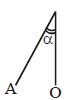
- 8Time period of a simple pendulum is $T$. The angular displacement for amplitude is $\beta$. How much time the bob of pendulum will take to move from equilibrium position $O$ to $A$, making an angle $\alpha$ at the supportView Solution
- 9A particle executes simple harmonic motion (amplitude $= A$) between $x = - A$ and $x = + A$. The time taken for it to go from $0$ to $A/2$ is ${T_1}$ and to go from $A/2$ to $A$ is ${T_2}$. ThenView Solution
- 10View SolutionThe graph shows the variation of displacement of a particle executing S.H.M. with time. We infer from this graph that