MCQ
Variation of atmospheric pressure, with height from earth is ................
  • A
    Linear
  • B
    Parabolic
  • Exponential
  • D
    Hyperbolic

Answer

Correct option: C.
Exponential
c
(c)

Variation of atmospheric pressure due to height is given by the barometric formula

$P_h=P_0 e ^{-m g h / R T}$

Hence the decrease will be exponential.

Need a full question paper?

Generate a complete, print-ready paper with questions like this in minutes — across 16+ boards, with answer keys.
Start Generating Free

Similar questions

Saturated vapour is compressed to half its volume without any change in temperature, then the pressure will be
The energy of a given sample of an ideal gas depends only on its:
In an experiment four quantities $a, b, c$ and $d$ are measured with percentage error $1\%, 2\%, 3\%$ and $4\%$ respectively. Quantity $w$ is calculated as follows $w\, = \,\frac{{{a^4}{b^3}}}{{{c^2}\sqrt D }}$  error in the measurement of $w$ is .......... $\%$
An electron and a proton are moving under the influence of mutual forces. In calculating the change in the kinetic energy of the system during motion, one ignores the magnetic force of one on another. This is because:
On a frictionless surface, a block of mass $M$ moving at speed $V$ collides elastically with another block of same mass $M$ which is initially at rest. After collision the first block moves at an angle $\theta$ to its initial direction and has a speed $\frac{V}{3}$ The second block's speed after the collision is
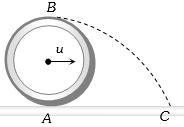
A wheel of radius $r$ rolls without slipping with a speed $v$ on a horizontal road. When it is at a point $A$ on the road, a small jump of mud separates from the wheel at its highest point $B$ and drops at point $C$ on the road. The distance $AC$ will be
The internal energy of an ideal gas depends upon
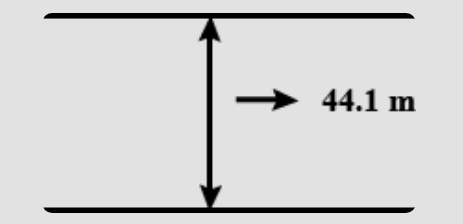
A stone is dropped into the water from a bridge 44.1m above the water. another stone is thrown vertically downward 1second later. both strike the water simultaneously. then initial speed of the second stone is:

A solid cylinder of mass $3\, kg$ is rolling on a horizontal surface with velocity $4\, m s^{- 1}$. It collides with a horizontal spring of force constant $200 \,N m^{-1}$. The maximum compression produced in the spring will be ............... $\mathrm{m}$
The behavior of real gases approaches that of ideal gas in which of these following conditions?