MCQ
$\vec{A}$ is a vector quantity such that $|\vec{A}|=$ nonzero constant. Which of the following expressions is true for $\vec{A}$ $?$
  • A
    $\overrightarrow{ A }\cdot \overrightarrow{ A }=0$
  • B
    $\overrightarrow{ A } \times \overrightarrow{ A }<0$
  • $\overrightarrow{ A } \times \overrightarrow{ A }=0$
  • D
    $\overrightarrow{ A } \times \overrightarrow{ A }>0$
Answer

Correct option: C.
$\overrightarrow{ A } \times \overrightarrow{ A }=0$
c
$|\overrightarrow{ A }| \neq 0$

$\overrightarrow{ A } \times \overrightarrow{ A }=|\overrightarrow{ A }||\overrightarrow{ A }| \sin 0^{\circ} \hat{ n }=0$

Need a full question paper?

Generate a complete, print-ready paper with questions like this in minutes — across 16+ boards, with answer keys.

Start Generating Free

Similar questions

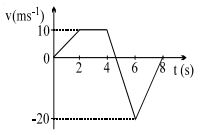
 The figure shows a velocity-time graph of a particle moving along a straight line. The particle comes to rest at $t=$ ....... $\sec$
The force required to stretch a wire of crosssection $1 cm ^{2}$ to double its length will be ........ $ \times 10^{7}\,N$

(Given Yong's modulus of the wire $=2 \times 10^{11}\,N / m ^{2}$ )

If the magnitude of sum of two vectors is equal to the magnitude of difference of the two vectors, the angle between these vectors is ........ $^o$
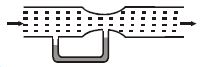
Water flows through the tube shown. Area of cross-section of wide and narrow part are $5$ $cm^2$ $\&$ $2$ $cm^2$. The rate of flow is $500$ $cm^3/sec$. Find difference in mercury level of $U-$ tube .......... $cm$
A particle moving with uniform speed in a circular path maintains:
A spherically symmetric gravitational system of particles has a mass density $\rho=\left\{\begin{array}{ll}\rho_0 & \text { for } r \leq R \\ 0 & \text { for } r>R\end{array}\right.$ where $\rho_0$ is a constant. A test mass can undergo circular motion under the influence of the gravitational field of particles. Its speed V as a function of distance $r(0 < r < \infty)$ from the centre of the system is represented by
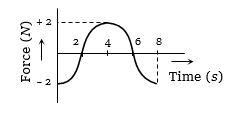
The force-time $(F -t) $ curve of a particle executing linear motion is as shown in the figure. The momentum acquired by the particle in time interval from zero to $8$ second will be  ........... $N-s$
An aeroplane of mass $3 \times 10^4\, kg$ and total wing area of $120\, m^2$ is in a level flight at some height. The difference in pressure between the upper and lower surfaces of its wings in kilopascals is $(g=10\,m/s^2)$
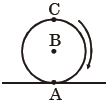
A sphere is rolling without slipping on a fixed horizontal plane surface. In the figure $A$ is the point of contact, $B$ is the centre of sphere and $C$ is its topmost point, then

$(i){\vec V_C} - {\vec V_A} = 2\left( {{{\vec V}_B} - {{\vec V}_C}} \right)$

$(ii){\vec V_C} - {\vec V_B} = {\vec V_B} - {\vec V_A}$

$(iii)\left| {{{\vec V}_C} - {{\vec V}_A}} \right| = 2\left| {{{\vec V}_B} - {{\vec V}_C}} \right|$

$(iv)\left| {{{\vec V}_C} - {{\vec V}_A}} \right| = 4\left| {{{\vec V}_B}} \right|$

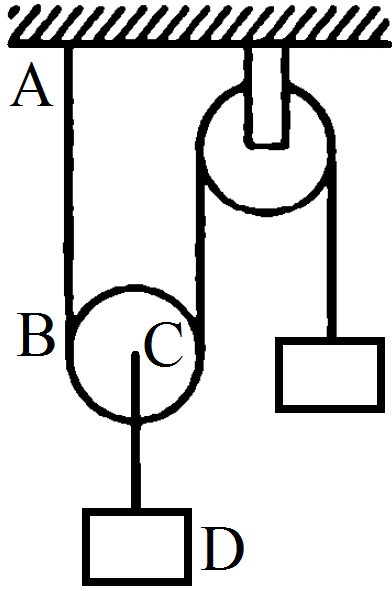
Both the strings, shown in figure are made of same material and have same cross-section. The pulleys are light. The wave speed of a transverse wave in the string AB is $\nu_1$ and in CD it is $\nu_2.$ Then $\frac{\nu_1}{\nu_2}$ is:

  1. $1$

  2. $2$

  3. $\sqrt{2}$

  4. $\frac{1}{\sqrt{2}}.$