MCQ
Velocity of transverse wave in stretched string doesn't depend on:
  • A
    Density
  • B
    Radius
  • C
    Tension
  • Length

Answer

Correct option: D.
Length
(D)

Need a full question paper?

Generate a complete, print-ready paper with questions like this in minutes — across 16+ boards, with answer keys.

Start Generating Free

Similar questions

Which is the correct unit for measuring nuclear radii
Four spheres of diameter $2a$ and mass $M$ are placed with their centres on the four corners of a square of side $b$ . Then the moment of inertia of the system about an axis along one of the sides of the square is
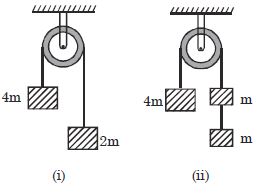
In the arrangement shown in figure, pulley is smooth and massles and all the strings are  light let $F_1$ be the force exerted on the pulley in case $(i)$ and $F_2$ the force in case $(ii)$. Then
$A$ child with mass $m$ is standing at the edge of a disc with moment of inertia $I$, radius $R$, and initial angular velocity $\omega$ . See figure given below. The child jumps off the edge of the disc with tangential velocity $v$ with respect to the ground. The new angular velocity of the disc is
A body of mass $m$ is moving in a circular orbit of radius $R$ about a planet of mass $M$. At some instant, it splits into two equal masses. The first mass moves in a circular orbit of radius $\frac{R}{2}$ , and the other mass, in a circular orbit of radius $\frac{3R}{2}$. The difference between the final and initial total energies is
A leak proof cylinder of length $1 \;\mathrm{m},$ made of a metal which has very low coefficient of expansion is floating vertically in water at $0^{\circ} \mathrm{C}$ such that its height above the water surface is $20\; \mathrm{cm} .$ When the temperature of water is increased to $4^{\circ} \mathrm{C},$ the height of the cylinder above the water surface becomes $21 \;\mathrm{cm} .$ The density of water at $\mathrm{T}=4^{\circ} \mathrm{C},$ relative to the density at $\mathrm{T}=0^{\circ} \mathrm{C}$ is close to
A disc rotating about its axis from rest, acquires the angular speed $100 \,rev/s$ in $4$ second. The angle rotated by it during these four seconds (in radian) is ...... $\pi$
The motion of a particle of mass m is given by $\text{x}=0$ for $\text{t} < 0\ \text{s},$ $\text{x}(\text{t})=\text{A}\sin4\text{p}\ \text{t}$ for $0<\text{t}<(1/ 4)\ \text{s}(\text{A}>\text{o}),$ and $\text{x}=0$ for $\text{t}>(1/4)\ \text{s}.$ Which of the following statements is true?
  1. The force at t = (1/8) s on the particle is $–16\pi^2 \text{A m.}$
  2. The particle is acted upon by on impulse of magnitude $4π^2\text{A m}$ at $\text{t} = 0$ s and t = (1/4) s.
  3. The particle is not acted upon by any force.
  4. The particle is not acted upon by a constant force.
  5. There is no impulse acting on the particle.
The phenomenon of beats can take place:
  1. For longitudinal waves only.
  2. For transverse waves only.
  3. For both longitudinal and transverse waves.
  4. For sound waves only.
Three identical bodies of equal mass $M$ each are moving along a circle of radius $R$ under the action of their mutual gravitational attraction. the speed of each body is