Question
Vibration magnetometer before use, should be set(a) In magnetic meridian(b) In geographical meridian(c) Perpendicular to magnetic meridian(d) In any position


Answer

(a) In magnetic meridian

Need a full question paper?

Generate a complete, print-ready paper with questions like this in minutes — across 16+ boards, with answer keys.
Start Generating Free

Similar questions

The minimum frequency $v$ of continuous $X-$rays is related to the applied potential difference $V$ as
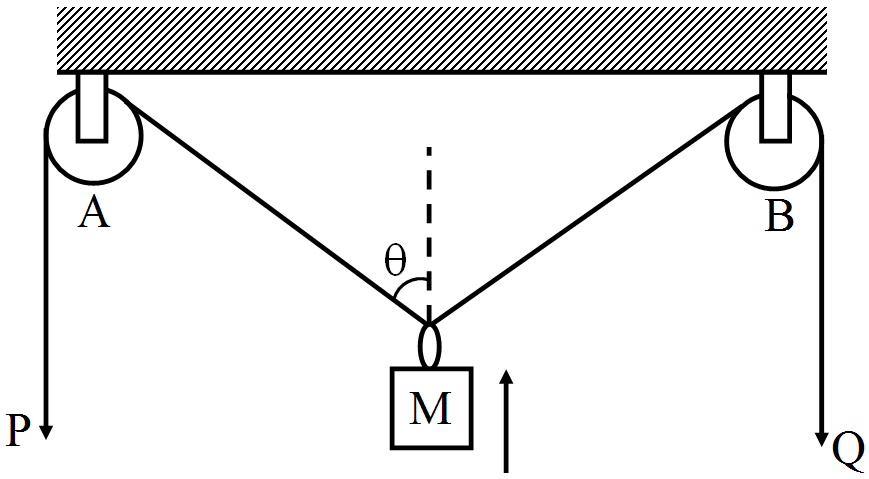
In the arrangement shown in figure, the ends P and Q of an inextensible string move downwards with uniform speed u. Pulleys A and B are fixed. The mass M moves upwards with a speed:
  1. $2\text{u}\cos\theta$
  2. $\frac{\text{u}}{\cos\theta}$
  3. $\frac{\text{2u}}{\cos\theta}$
  4. $\text{u}\cos\theta$
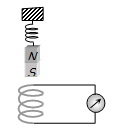
A magnet $NS$ is suspended from a spring and while it oscillates, the magnet moves in and out of the coil $C.$ The coil is connected to a galvanometer $G.$ Then as the magnet oscillates,
The graph of ln$\Big(\frac{\text{R}}{\text{R}_{\text{0}}}\Big)$ versus In A (R = radius of a nucleus and A - its mass number) is:
The mass equivalent of $931\ \text{MeV}$ energy is
In physics, chemistry, and electronic engineering, _______________ is the lack of an electron at a position where one could exist in an atom or atomic lattice.
Let $\vec{\text{F}}$ be a force acting on a particle having position vector $\vec{\text{r}}.$ Let $\vec{\tau}$ be the torque of this force about the origin, then:
  1. $\vec{\text{r}}.\vec{\text{F}}=0$ and $\vec{\text{F}}.\vec{\tau}=0$
  2. $\vec{\text{r}}.\vec{\tau}=0$ but $\vec{\text{F}}.\vec{\tau}\neq0$
  3. $\vec{\text{r}}.\vec{\tau}\neq0$ but $\vec{\text{F}}.\vec{\tau}=0$
  4. $\vec{\text{r}}.\vec{\tau}\neq0$ and $\vec{\text{F}}.\vec{\tau}\neq0$
An LCR circuit has L = 10 mH, $\text{R}=3\Omega$ and $\text{C}=1\mu\text{ F}$ connected in series to a source of $15\cos\omega\text{t}$ volt. The current amplitude at a frequency that is 10% lower than the resonant frequency is:
A parallel plate air capacitor is charged to a potential difference of V. After disconnecting the battery, distance between the plates of the capacitor is increased using an insulating handle. As a result, the potential difference between the plates(a) Decreases(b) Increases(c) Becomes zero(d) Does not change
       
Light travels through a glass plate of thickness $t$ and having refractive index $n.$ If $c$ is the velocity of light in vacuum, the time taken by the light to travel this thickness of glass is