MCQ
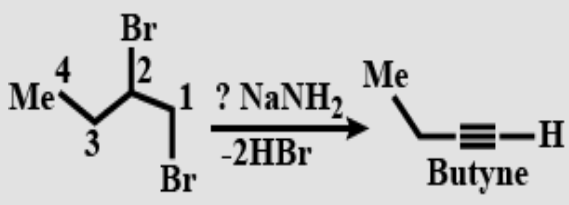
- AOne
- BTwo
- CThree
- DFour
Explanation:
In the first step, one mole NaNH2 is the base in an elimination reaction to give the alkenyl bromide.
In the second reaction, likewise a second equivalent of NaNH2 performs a second elimination reaction to form the alkyne.
For a terminal alkyne, any excess NaNH2 will remove the acidic hydrogen from terminal C−H and give the alkynyl anion.
So if a terminal alkyne is formed, three equivalents of NaNH2 will be consumed; the alkyne is protonated upon workup, usually by adding water.
Generate a complete, print-ready paper with questions like this in minutes — across 16+ boards, with answer keys.
$A$. $\mathrm{Ar}$ $B$. $\mathrm{Br}$ $C. F$ $D$. $\mathrm{S}$
Choose the most appropriate from the options given below: