MCQ
Vinegar obtained from sugarcane has
  • $C{H_3}COOH$
  • B
    $HCOOH$
  • C
    ${C_6}{H_5}COOH$
  • D
    $C{H_3}C{H_2}COOH$

Answer

Correct option: A.
$C{H_3}COOH$
a
(a)Acetic acid is the chief constituent of vinegar and hence its name (Latin : acetum = vinegar).

Need a full question paper?

Generate a complete, print-ready paper with questions like this in minutes — across 16+ boards, with answer keys.
Start Generating Free

Similar questions

If $\Delta_0< P$ then correct configuration for $d^4$ would be-
Which alkali metal carbonate decomposes on heating to liberate $C{O_2}$ gas
The de-Broglie's wavelength of an electron in the $4^{\text {th }}$ orbit is . . . . . . . . $\pi a_0 .\left(a_0=\right.$ Bohr's radius)
${C_2}{H_5}Br\,\xrightarrow{{AgCN}}X\xrightarrow[{Zn - Hg/HCl}]{{{\text{Reduction}}}}Y,$ Here $Y$ is
The conductivity of a solution of complex with formula $CoCl _{3}\left( NH _{3}\right)_{4}$ corresponds to $1: 1$ electrolyte, then the primary valency of central metal ion is
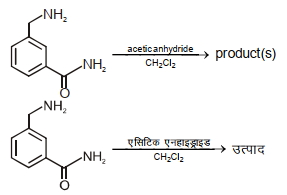
In the reaction shown below, the major product$(s)$ formed is/are
Which of the following are intermediates in Sandmeyer reaction ?

$(i)$ ${C_6}{H_5}{N^ + } \equiv NC{l^ - }$ $(ii)$ ${C_6}{H_5}{N^ + } \equiv N$
$(iii)$ ${{\overset{\centerdot }{\mathop{C}}\,}_{6}}{{H}_{5}}$ $(iv)$ $C_6H_5Cl$

When $800\,mL$ of $0.5\,M$ nitric acid is heated in a beaker, its volume is reduced to half and $11.5\,g$ of nitric acid is evaporated. The molarity of the remaining nitric acid solution is $x \times 10^{-2}\,M$.(Nearest Integer)(Molar mass of nitric acid is $63\,g\,mol ^{-1}$ )
For an electrochemical cell

$\mathrm{Sn}(\mathrm{s})\left|\mathrm{Sn}^{2+}(\mathrm{aq}, 1 \mathrm{M}) \| \mathrm{Pb}^{2+}(\mathrm{aq}, 1 \mathrm{M})\right| \mathrm{Pb}(\mathrm{s})$

the ratio $\frac{\left[\mathrm{Sn}^{2+}\right]}{\left[\mathrm{Pb}^{2+}\right]}$ when this cell attains equilibrium is

(Given $\mathrm{E}_{\mathrm{Sn}^{2+} / \mathrm{Sn}}^{0}=-0.14 \mathrm{\;V}$ $\left.\mathrm{E}_{\mathrm{Pb}^{+2}/{\mathrm{Pb}}}^{0}=-0.13 \;\mathrm{V}, \frac{2.303 \mathrm{RT}}{\mathrm{F}}=0.06\right)$

In which of the following process, highest energy is absorbed ?