Question
Water flows through a cylindrical pipe, whose inner radius is 1cm, at the rate of 80cm/ sec in an empty cylindrical tank, the radius of whose base is 40cm. What is the rise of water level in tank in half an hour?

Answer

Main concept: Volume of flowing water $\text{A}.\upsilon.\text{t}$ Area of base = A = Area of cross-section of flowing water height = distance = speed × time $\upsilon.\text{t}$ Flowing water is filled in cylindrical tank. Hence, the volume of flowing water is equal to volume of water in cylindrcical tank.Flowing water:
$\text{A}=\pi\text{r}^2(\text{cylinder})$ $​​\upsilon=80\text{cm/s}$Cylinder:
R = 40cm H = x $\text{r}=1\text{cm and t}=\frac{1}{2}\text{hr}=\frac{1}{2}\times3600\sec=1800\sec$ $\therefore$ Volume of water in cylindrical tank = Volume of flowing water $\Rightarrow\ \ \pi\text{R}^2\text{H}=\text{A}.\upsilon.\text{t}$ $\Rightarrow\ \ \pi\text{R}^2\text{H}=\pi\text{r}^2\upsilon.\text{t}$ $\Rightarrow\ \ 40\times40\times\text{x}=1\times1\times80\times1800$ $\Rightarrow\ \ \text{x}=\frac{80\times1800}{40\times40}=5\times18=90\text{cm}$ Hence, the rise of water level in cylindrical tank is 90cm.

Need a full question paper?

Generate a complete, print-ready paper with questions like this in minutes — across 16+ boards, with answer keys.
Start Generating Free

Similar questions

Solve the following systems of equations by using the method of cross multiplication:
$\frac{\text{a}}{\text{x}}-\frac{\text{b}}{\text{y}}=0$
$\frac{\text{ab}^2}{\text{x}}+\frac{\text{a}^2\text{b}}{\text{y}}=\text{a}^2+\text{b}^2,$ where $\text{x}\neq0$ and $\text{y}\neq0$
Solve the following quadratic equations by factorization:
$\frac{\text{m}}{\text{n}}\text{x}^2+\frac{\text{n}}{\text{m}}=1-2\text{x}$
If $\text{x}=\text{a}\cos^3\theta$ and $\text{y}=\text{b}\sin^3\theta,$ prove that $\Big(\frac{\text{x}}{\text{a}}\Big)^\frac{2}{3}+\Big(\frac{\text{y}}{\text{b}}\Big)^\frac23=1.$
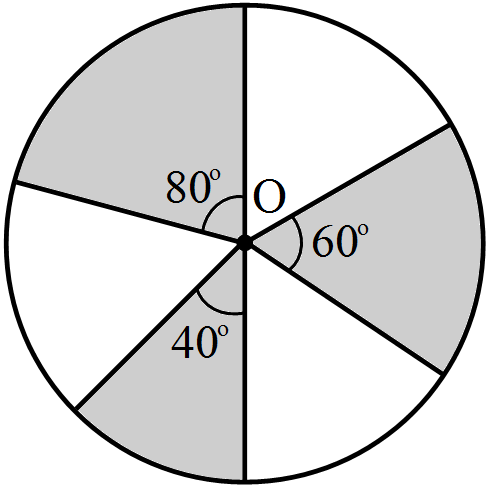
In the given figure, three sectors of a circle of radius 7cm, making angles of 60°, 80° and 40° at the centre are shaded. Find the area of the shaded region.
If $\sec\theta=\frac{5}{4},$ show that $\frac{\big(\sin\theta-2\cos\theta\big)}{\big(\tan\theta-\cot\theta\big)}=\frac{12}{7}.$
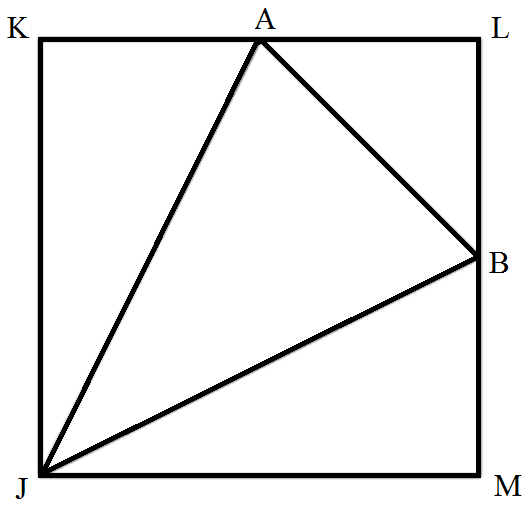
In the given figure, JKLM is a square with sides of length 6 units. Points A and B are the mid points of sides KL and LM respectively. If a point is selected at random from the interior of the square. What is the probability that the point will be chosen from the interior of $\triangle\text{JAB}.$
Find the $12^{th}$ term from the end of the following arithmetic progressions:
$1, 4, 7, 10, ....., 88.$
Find the value of k for which each of the following system of equations have infinitely many solutions:
$2x + 3y = k$
$(k - 1)x + (k + 2)y = 3k$
Solve the following quadratic equation:
$\frac{1}{\text{x}-1}-\frac{1}{\text{x}+5}=\frac{6}{7},$ $\text{x}\neq1,\ -5$
The median of the following data is $525.$ Find the values of $x$ and $y,$ if the total frequency is $100.$
Class interval Frequency
$0-100$ $2$
$100-200$ $5$
$200-300$ $X$
$300-400$ $12$
$400-500$ $17$
$500-600$ $20$
$600-700$ $y$
$700-800$ $9$
$800-900$ $7$
$900-1000$ $4$