Question
Water flows through a horizontal pipe of which the cross-section is not constant. The pressure is 1cm of mercury where the velocity is 0.35m/s. Find the pressure at a point where the velocity is 0.65m/s.

Answer

For streamlined flow, the sum of the pressure head, velocity head and gravitational head is a constant, i.e.,$\frac{\text{P}}{\rho\text{g}}+\frac{\text{v}^2}{2\text{g}}+\text{h}=\text{Constant}$
Taking h the same, we have,$\frac{\text{P}_1}{\rho\text{g}}+\frac{\text{v}^2_1}{2\text{g}}=\frac{\text{P}_2}{\rho\text{g}}+\frac{\text{v}^2_2}{2\text{g}}$
$1+\frac{(0.35)^2}{2\text{g}}=\frac{\text{P}_2}{\rho\text{g}}+\frac{(0.65)^2}{2\text{g}}$
$\text{P}_2=\frac{(0.35)^2-(0.65)^2}{2\text{g}}+1$
$=1-\frac{0.3}{2\text{g}}$
$=1-0.015=0.985$
$\therefore$ Pressure = 0.985cm

Need a full question paper?

Generate a complete, print-ready paper with questions like this in minutes — across 16+ boards, with answer keys.
Start Generating Free

Similar questions

The ratio of radius of two wires of the same metal is 2 : 1. If they are pulled by applying equal force, what will be the ratio of stresses?
By using the method of dimension, check the accuracy of the following $\text{T}=\frac{\text{rh } \rho\text{g}}{2\cos\theta}$ where T is the surface tension, h is the height of the liquid in a capillary tube, $\rho$ is the density of the liquid, g is the acceleration due to gravity, $\theta$ is the angle of contact, and r is the radius of the capillary tube.
Can you associate vectors with $(a)$ the length of a wire bent into a loop, $(b)$ a plane area, $(c)$ a sphere? Explain
 A train standing at the outer signal of a railway station blows a whistle of frequency $400 Hz$ still air. The train begins to move with a speed of $10 m s ^{-1}$ towards the platform. What is the frequency of the sound for an observer standing on the platform? (sound velocity in air = $\left.330 m s ^{-1}\right)$
A man can swim with a speed of $4.0km/h$ in still water. How long does he take to cross a river $1.0km$ wide if the river flows steadily at $3.0km/h$ and he makes his strokes normal to the river current? How far down the river does he go when he reaches the other bank?
A simple pendulum of length l and having a bob of mass M is suspended in a car. The car is moving on a circular track of radius R with a uniform speed v. If the pendulum makes small oscillations in a radial direction about its equilibrium position, what will be its time period?
In a $p-n$ junction, the depletion region is $400\ nm$ wide and an electric field of $5 \times 10^5V/m$ exists in it.
  1. Find the height of the potential barrier.
  2. What should be the minimum kinetic energy of a conduction electron which can diffuse from the $n-$side to the $p-$side?
If the horizontal force needed for the turn in the previous problem is to be supplied by the normal force by the road, what should be the proper angle of banking?
Time for $20$ oscillations of a pendulum is measured as $t_1 = 39.6s; t_2 = 39.9s; t_3 = 39.5s$. What is the precision in the measurements? What is the accuracy of the measurement?
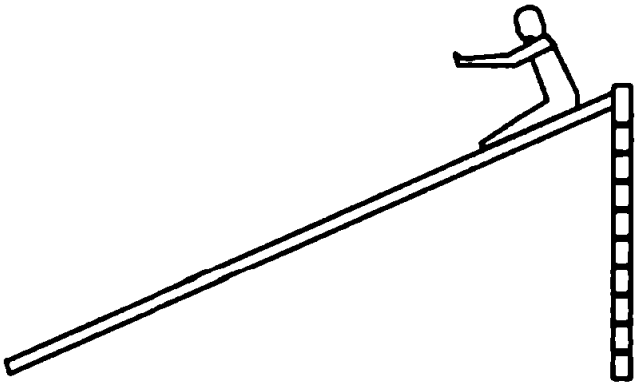
In a children's park, there is a slide which has a total length of 10m and a height of 8.0m (figure). Vertical ladder are provided to reach the top. A boy weighing 200N climbs up the ladder to the top of the slide and slides down to the ground. The average friction offered by the slide is three tenth of his weight. Find
  1. The work done by the ladder on the boy as he goes up.
  2. The work done by the slide on the boy as he comes down. Neglect any work done by forces inside the body of the boy.