MCQ
Water waves produced by a motor boat sailing in water are:
  • A
    Neither longitudinal nor transverse.
  • Both longitudinal and transverse.
  • C
    Only longitudinal.
  • D
    Only transverse.

Answer

Correct option: B.
Both longitudinal and transverse.
As the waves are produced by motor boat on surface as well as inside water, the waves are both, transverse as well as longitudinal.

Need a full question paper?

Generate a complete, print-ready paper with questions like this in minutes — across 16+ boards, with answer keys.
Start Generating Free

Similar questions

A sound wave is passing through air column in the form of compression and rarefaction. In consecutive compressions and rarefactions:
The height $y$ and the distance $x$ along the horizontal plane of a projectile on a certain planet (with no surrounding atmosphere) are given by $y = (8t - 5{t^2})$ meter and $x = 6t\, meter$, where $t$ is in second. the angle with the horizontal at which the projectile was projected is
What is the phase difference between two successive crests in the wave
The escape velocity of an object on a planet whose $g$ value is $9$ times on earth and whose radius is $4$ times that of earth in $km/s$ is
A body of mass ${M}$ moving at speed ${V}_{0}$ collides elastically with a mass $'m'$ at rest. After the collision, the two masses move at angles $\theta_{1}$ and $\theta_{2}$ with respect to the initial direction of motion of the body of mass ${M}$. The largest possible value of the ratio ${M} / {m}$, for which the angles $\theta_{1}$ and $\theta_{2}$ will be equal, is :
 A $10 \;N$ force is applied on a body produce in it an acceleration of $1 \;m / s ^{2} .$ The mass of the body is ...... $kg$
A tennis ball dropped from a height of $2 \,m$ rebounds only $1.5 \,m$ after hitting the ground. What fraction of its energy is lost in the impact
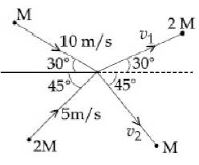
Two particles, of masses $M$ and $2M$, moving as shown, with speeds of $10\, m/s$ and $5\, m/s$, collide elastically at the origin. After the collision, they move along the indicated directions with speeds $v_1$ and $v_2$ respectively. The value of $v_1$ and $v_2$ are nearly
A $2\,kg$ chain is in the form of a heap. Its length is $2\,m$. Its one end is being pulled at constant speed of $2\,m/s$ horizontally. The power delivered to the chain is (in $W$).
Two circular discs $\sqrt {2gh} $ and $B$ are of equal masses and thickness but made of metals with densities ${d_A}$ and ${d_B}$ $({d_A} > {d_B})$. If their moments of inertia about an axis passing through centres and normal to the circular faces be ${I_A}$ and ${I_B}$, then