Question
Watt-hour meter measures
|
(a) Electric energy |
(b) Current |
(c) Voltage |
(d) Power |
Watt-hour meter measures
|
(a) Electric energy |
(b) Current |
(c) Voltage |
(d) Power |
(a) Electric energy
Generate a complete, print-ready paper with questions like this in minutes — across 16+ boards, with answer keys.
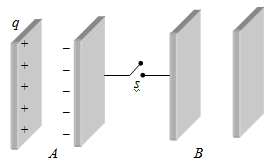
Consider the situation shown in the figure. The capacitor A has a charge q on it whereas B is uncharged. The charge appearing on the capacitor B a long time after the switch is closed is
|
(a) Zero |
(b) q/2 |
(c) q |
(d) 2q |
A photon and an electron have equal energy E. 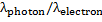 is proportional to
|
(a) |
(b) 1/ |
|
(c) 1/E |
(d) Does not depend upon E |
When the angle of incidence on a material is 60°, the reflected light is completely polarized. The velocity of the refracted ray inside the material is (in ms–1)
|
(a) 3 |
(b) |
(c) |
(d) 0.5 |
The average e.m.f. induced in a coil in which the current changes from 2 ampere to 4 ampere in 0.05 second is 8 volt. What is the self inductance of the coil ?
|
(a) 0.1 H |
(b) 0.2 H |
(c) 0.4 H |
(d) 0.8 H |
A uniform wire is bent in the form of a circle of radius R. A current I enters at A and leaves at C as shown in the figure :
If the length ABC is half of the length ADC, the magnetic field at the centre O will be

|
(a) Zero |
(b) |
(c) |
(d) |
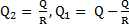
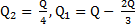
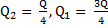
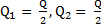
A total charge Q is broken in two parts  and
and  and they are placed at a distance R from each other. The maximum force of repulsion between them will occur, when
|
(a) |
(b) |
|
(c) |
(d) |
The value of internal resistance of an ideal cell is
|
(a) Zero |
(b) 0.5 Ω |
(c) 1 Ω |
(d) Infinity |