MCQ
Wave nature of light follows because
  • A
    Light rays travel in a straight line
  • B
    Light exhibits the phenomena of reflection and refraction
  • Light exhibits the phenomenon of interference
  • D
    Light causes the phenomenon of photoelectric effect

Answer

Correct option: C.
Light exhibits the phenomenon of interference
c
(c)Interference is explained by wave nature of light.

Need a full question paper?

Generate a complete, print-ready paper with questions like this in minutes — across 16+ boards, with answer keys.
Start Generating Free

Similar questions

Atomic mass number of an element thorium is 232 and its atomic number is 90. The end product of this radioactive element is an isotope of lead (atomic mass 208 and atomic number 82). The number of alpha and beta particles emitted is
A long solenoid has a radius a and number of turns per unit length is n. If it carries a current i, then the magnetic field on its axis is directly proportional to
If modulation index $\mu=\frac{1}{2}$ and $V_{ M }=2$ then $V_{ c }=\,?$
A charge $q$ moves in a region where electric field and magnetic field both exist, then force on it is
Optoelectronic devices work on:
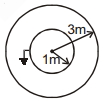
Figure shows a solid conducting sphere of radius $1 m$, enclosed by a metallic shell of radius $3 \,m$ such that their centres coincide. If outer shell is given a charge of $6 \,\mu C$ and inner sphere is earthed, find magnitude charge on the surface of inner shell is ............. $\mu C$
In an electron microscope, the resolution that can be achieved is of the order of the wavelength of electrons used. To resolve a width of $7.5 \times 10^{-12}\, m$, the minimum electron energy required is close to .............. $keV$
The power is transmitted from a power house on high voltage $ac$ because
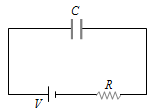
As in figure shown, if a capacitor C is charged by connecting it with resistance R, then energy is given by the battery will be
The de-Broglie wavelength of a particle accelerated with $150 volt$ potential is ${10^{ - 10}}m$. If it is accelerated by $600 volts$ $ p.d.$, its wavelength will be ........... $\mathop A\limits^o $