MCQ
Wavefront of a wave has direction with wave motion
  • A
    Parallel
  • Perpendicular
  • C
    Opposite
  • D
    At an angle of ?

Answer

Correct option: B.
Perpendicular
Perpendicular

Need a full question paper?

Generate a complete, print-ready paper with questions like this in minutes — across 16+ boards, with answer keys.

Start Generating Free

Similar questions

The magnifying power of a simple microscope is $6$. The focal length of its lens in metres will be, if least distance of distinct vision is $25\,cm$
A tall man of height $6$ feet, want to see his full image. Then required minimum length of the mirror will be$-$
Relation between current $I$ flowing in moving coil galyanometer and deflection $\theta$ is :
Two identical charged spheres are suspended by strings of equal lengths. The strings make an angle of $30^{\circ}$ with each other. When suspended in a liquid of density $0.8 \;g\, cm ^{-3}$, the angle remains the same. If density of the material of the sphere is $1.6\; g \,cm ^{-3}$, the dielectric constant of the liquid is
Unit of magnetic flux density (or magnetic induction) is
Two parallel long wires carry currents $i_1$ and $i_2$ with ${i_1} > {i_2}$. When the currents are in the same direction, the magnetic field midway between the wires is $10\, \mu T$. When the direction of $i_2$ is reversed, it becomes $40 \,\mu T$. the ratio ${i_1}/{i_2}$ is
A plane electromagnetic wave of frequency $25 \;MHz$ travels in free space along the $x$ -direction. At a particular point in space and time, $E = 6.3\,\hat j\;\,V/m$. What is $B$ at this point? 
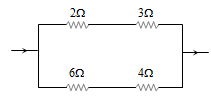
In the circuit as shown in the figure, the heat produced by 6 ohm resistance due to current flowing in it is 60 calorie per second. The heat generated across 3 ohm resistance per second will be
Find the luminous intensity of the sun if it produces the same illuminance on the earth as produced by a bulb of $10000 \,candela$ at a distance $0.3 m.$ The distance between the sun and the earth is $1.5 \times {10^{11}}m$
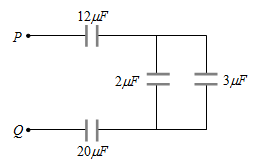
In the circuit diagram shown in the adjoining figure, the resultant capacitance between P and Q is