Question
We can see the sun even when it is little below the horizon.

Answer

(i) By sunrise we mean the appearance of the sun above the horizon.
(ii) When the Sun is some what below the horizon, its light rays are able to reach us along a curved path due to their refraction through Earths atmosphere.
(iii) Thus we see the Sun even before it emerges above the horizon.
(iv) Same thing happens at the time of sunset, we keep seeing the Sun for a short while even after it goes below horizon.

Need a full question paper?

Generate a complete, print-ready paper with questions like this in minutes — across 16+ boards, with answer keys.

Start Generating Free

Similar questions

Sketch the labelled diagrams: Human female reproductive system.
Balance the following equation stepwise:$Ag _{( s )}+ HCl _{(1)} \rightarrow AgCl \downarrow+ H _2 \uparrow$
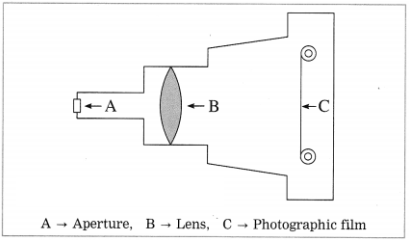
The human eye is very similar to a photographic camera. The figure given shows the main parts of a photographic camera. Now answer the following questions:
Image
(1) Name the parts of the human eye similar to the following parts of the photographic camera :
(a) Photographic film (b) Aperture.
(2) State one difference between the human eye lens and camera lens.
(3) Name the muscles which adjust the curvature of the eye lens.
(4) Which phenomenon of light is responsible for the working of the eye?
An organic acid $X$ is a liquid, which often freezes during winter time in cold countries, having the molecular formula $C_2H_4O_2.$ On warming it with methanol in the presence of a few drops of concentrated sulphuric acid, a compound $Y$ with a sweet smell is formed.
  1. Identify $X$ and $Y.$ Also write their formulae showing the functional group present in them.
  2. Write a chemical equation for the reaction involved.
State the importance of Space Mission.
Draw a labelled diagram to show the domestic electric wiring from an electric pole to a room. Give the wiring for a bulb and a three-pin socket only.
Answer the following:
i. What are the factors affecting the rate of chemical reaction?
ii. Explain any one factor.
A potential difference of 100 V is applied across a resistor of resistance 50 Ω for 6 minutes and 58 seconds. Find the heat produced in (i) joule (ii) calorie.
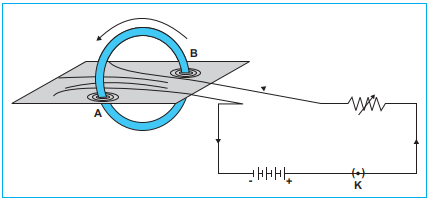
Take a rectangular cardboard with two holes. Take a coil of large numbers of turns. Insert the coil through the holes such that the turns are normal to the plane of the cardboard. Connect two ends of the coil in series with battery, a key and a rheostat as shown in figure 5.15. Sprinkle iron filings uniformly on the cardboard. Plug the key, tap the cardboard gently. Note your observations.
Image
Which type of lens is:
  1. A converging lens, and which is.
  2. A diverging lens? Explain your answer with diagrams.