We have a galvanometer of resistance $25\,\Omega $. It is shunted by a $2.5\,\Omega $ wire. The part of total current that flows through the galvanometer is given as
Medium
Download our app for free and get started
(a) $\frac{i}{{{i_g}}} = \frac{{G + S}}{S}$
$ \Rightarrow $ $\frac{{{i_g}}}{i} = \frac{S}{{G + S}} = \frac{{2.5}}{{27.5}} = \frac{1}{{11}}$

Download our appand get started for free
Experience the future of education. Simply download our apps or reach out to us for more information. Let's shape the future of learning together!No signup needed.*
Similar Questions
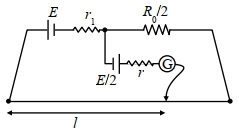
- 1In order to measure the internal resistance $r_1$ of a cell of emf $E$, a meter bridge of wire resistance $R_0=50 \Omega$, a resistance $R_0 / 2$, another cell of emf $E / 2$ (internal resistance $r$ ) and a galvanometer $G$ are used in a circuit, as shown in the figure. If the null point is found at $l=72 cm$, then the value of $r_1=$ . . . . $\Omega$View Solution
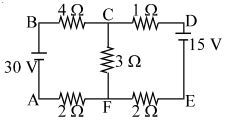
- 2The figure shows a network of five resistances and two batteries The total electrical power consumed by the circuit is ............... $W$View Solution
- 3A current $I$ is passing through a wire having two sections $P$ and $Q$ of uniform diameters $d$ and $d/2$ respectively. If the mean drift velocity of electrons in sections $P$ and $Q$ is denoted by $v_P$ and $v_Q$ respectively, thenView Solution
- 4Equivalent resistance between the adjacent corners of a regular $n$-sided polygon of uniform wire of resistance $R$ would be:View Solution
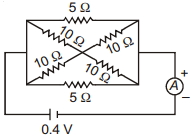
- 5Calculate the current shown by the ammeter $A$ in the circuit diagram is .............. $A$View Solution
- 6A current of $1.6\, A$ is flowing through a wire having cross-sectional area $1\, mm^2$. If density of free electrons in the material of the wire is $10^{29}\, per\, m^3$, the drift velocity of electrons will beView Solution
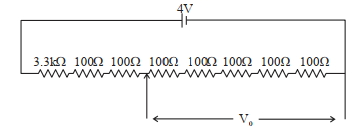
- 7A potential divider circuit is shown in figure. The output voltage $V_0$ isView Solution
- 8A cylindrical conductor has uniform cross-section. Resistivity of its material increase linearly from left end to right end. If a constant current is flowing through it and at a section distance $x$ from left end, magnitude of electric field intensity is $E$, which of the following graphs is correctView Solution
- 9The ammeter reading in the circuit below is .............. $A$View Solution
- 10A railway compartment is lit up by thirteen lamps each taking $2.1\, amp$ at $15\, volts$. The heat generated per second in each lamp will be ............ $cal$View Solution