Question
We have carefully distinguished between average speed and magnitude of average velocity. No such distinction is necessary when we consider instantaneous speed and magnitude of velocity. The instantaneous speed is always equal to the magnitude of instantaneous velocity. Why?
Answer

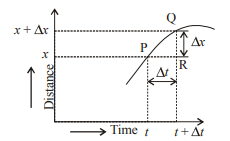
The instantaneous velocity of an object is equal to the velocity of the object at that instant is called the limiting instantaneous speed of the mean velocity. Thus, when the time interval is minute, the magnitude of displacement is effectively equal to the distance covered by the object in the same minute time interval. Hence in this case instantaneous velocity and instantaneous speed are equal. This can be understood by the following :
Image
The instantaneous velocity of a moving object will be equal to its average velocity if the interval $\Delta t$ between its two times $( t$ and $t +\Delta t$ ) is infinitely small.
Mean velocity over time interval $\Delta t$
$
=\frac{\Delta x}{\Delta t}
$
Instantaneous velocity at instant t
$
\begin{array}{r}
\qquad \lim _{\Delta t \rightarrow 0} \frac{\Delta x}{\Delta t}=\frac{d x}{d t} \quad\quad...(1)\\
\text { Mean speed }=\frac{\text { Total distance }}{\text { Total time }}=\frac{\text { Arc PQ }}{\Delta t}
\end{array}
$
$
\begin{aligned}
\text { Instantaneous speed } & =\lim _{\Delta t \rightarrow 0} \text { mean speed } \\
& =\lim _{\Delta t \rightarrow 0} \frac{Arc PQ}{\Delta t}=\lim _{\Delta t \rightarrow 0} \frac{PQ}{\Delta t} \\
& =\lim _{\Delta t \rightarrow 0} \frac{PQ}{\Delta t}\quad\quad...(2)
\end{aligned}
$
Here $PQ = PQ$ is length of line.
From $\triangle PQR ,( PQ )^2=( PR )^2+( QR )^2$
like $\Delta t \rightarrow 0, PQ \rightarrow QR$ or $PQ \rightarrow \Delta x$
From equation (2) instantaneous speed $=\lim _{\Delta t \rightarrow 0} \frac{\Delta x}{\Delta t}=\frac{d x}{d t}$
i.e., magnitude of instantaneous velocity.

Need a full question paper?

Generate a complete, print-ready paper with questions like this in minutes — across 16+ boards, with answer keys.

Start Generating Free

Similar questions

A rod, when suspended in a magnetic field, stays in the east-west direction. Can we be sure that the field is in the east-west direction? Can it be in the north-south direction?
Use the formula $\text{v}=\sqrt{\frac{\gamma\text{P}}{\rho}}$ to explain why the speed of sound in air:
Increases with temperature,
A mass 5kg starts sliding from A on a smooth surface shown in the figure. Find the velocity of the mass at B and C?

Find the expression of the position of the center of mass of a system of n-particles.
From a uniform disk of radius R , a circular hole of radius $\frac{R}{2}$ is cut out. The centre of the hole is at $\frac{R}{2}$ from the centre of the original disc. Locate the centre of gravity of the resulting flat body.
A woman starts from her home at 9.00 am, walks with a speed of 5km h–1 on a straight road up to her office 2.5km away, stays at the office up to 5.00 pm, and returns home by an auto with a speed of 25km h–1. Choose suitable scales and plot the x-t graph of her motion.
In an experiment on photoelectric effect, the stopping potential is measured for monochromatic light beams corresponding to different wavelengths. The data collected are 11s follows:

wavelength (nm) 350 400 450 500 550
stopping potential(V): 1.45 1.00 0.66 0.38 0.16

Plot the stopping potential against inverse of wavelength $\big(\frac{1}{\lambda}\big) $ on a graph paper and find

  1. The Planck constant,
  2. The work function of the emitter and.
  3. The threshold wavelength.
A particle of mass m is kept on the top of a smooth sphere of radius R. It is given a sharp impulse which imparts it a horizontal speed v.
  1. Find the normal force between the sphere and the particle just after the impulse.
  2. What should be the minimum value of v for which the particle does not slip on the sphere?
  3. Assuming the velocity v to be half the minimum calculated in part.
  4. Find the angle made by the radius through the particle with the vertical when it leaves the sphere.

A box of 1.00m3 is filled with nitrogen at 1.5 atm at 300K. The box has a hole of an area 0.010 mm2. How much time is required for the pressure to reduce by 0.10atm, if the pressure outside is 1atm.
Prove that the total speed of a particle in simple harmonic motion energy is directly proportional to the square of the particle's amplitude and the square of its frequency.