Question
We have valence electrons and conduction electrons in a semiconductor. Do we also have 'valence holes' and 'conduction holes'?

Answer

Holes do not exist in reality. They exist only virtually. When an electron jumps from the valence band to the conduction band, a vacancy is created at the place from where the electron had jumped. This vacancy is called a hole. So, a valence or conduction hole is a virtual concept only.

Need a full question paper?

Generate a complete, print-ready paper with questions like this in minutes — across 16+ boards, with answer keys.
Start Generating Free

Similar questions

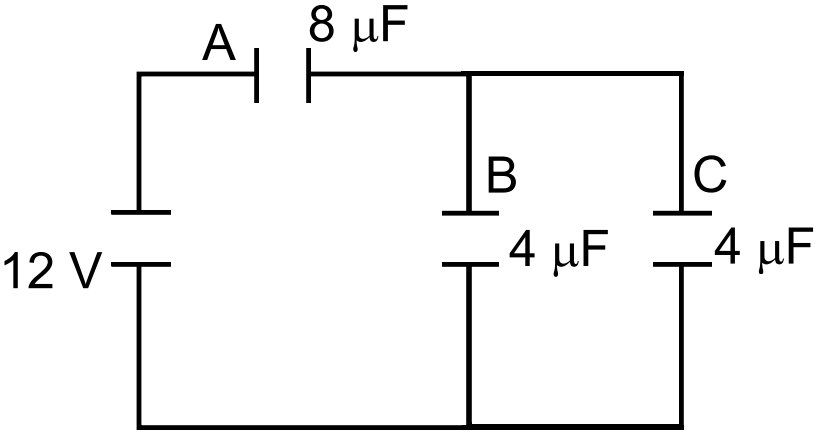
Find the charge appearing on each of the three capacitors shown in figure.

A tank is filled with water to a height of 12.5 cm. The apparent depth of a needle lying at the bottom of the tank is measured by a microscope to be 9.4 cm. What is the refractive index of water? If water is replaced by a liquid of refractive index 1.63 up to the same height, by what distance would the microscope have to be moved to focus on the needle again?
  1. Write the functions of the three segments of a transistor.
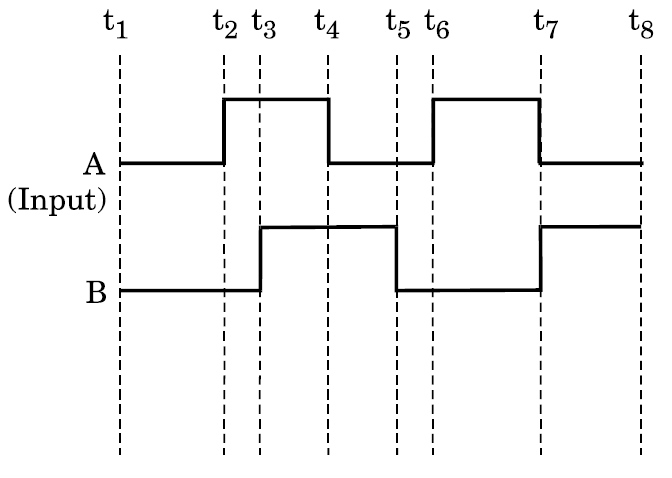
  2. The figure shows the input waveforms A and B for ‘AND’ gate. Draw the output waveform and write the truth table for this logic gate.

For given time interval. Show the graphical representation at different angles for some $\alpha$-particle scattering.
ls it always true that for two sources of equal intensity, the number of photons emitted in a given time are equal?
Do all the thermocouples have a neutral temperature?
A thin prism is made of a material having refractive indices 1.61 and 1.65 for red and violet light. The dispersive power of the material is 0.07. It is found that a beam of yellow light passing through the prism suffers a minimum deviation of 4.0° in favourable conditions. Calculate the angle of the prism.
What is the energy of a hydrogen atom in the first excited state if the potential energy is taken to be zero in the ground state?
  1. A screen is placed at a distance of 100 cm from an object. The image of the object is formed on the screen by a convex lens for two different locations of the lens separated by 20 cm. Calculate the focal length of the lens used.
  2. A converging lens is kept coaxially in contact with a diverging lens - both the lenses being of equal focal length. What is the focal length of the combination?
  1. Show, with the help of a diagram, how unpolarised sunlight gets polarised due to scattering.
  2. Two polaroids P1 and P2 are placed with their pass axes perpendicular to each other. Unpolarised light of intensity Io is incident on P1. A third polaroid P3 is kept in between Pand P2 such that its pass axis makes an angle of $45^{\circ}$ with that of P1. Determine the intensity of light transmitted through P1, P2 and P3.