Question
We often say, "A current is going through the wire." What goes through the wire, the charge or the current?
Answer

Only charge goes from the wire, rate of flow of charge is known as current.

Need a full question paper?

Generate a complete, print-ready paper with questions like this in minutes — across 16+ boards, with answer keys.

Start Generating Free

Similar questions

Define electric flux.
The power factor of an $a.c.$ circuit is $0.5.$ What is the phase difference between voltage and current in the circuit?
A sample of $\text{HCI}$ gas is placed in an electric field of $2.5 \times 10^4NC^{-1}.$ The dipole moment of each $\text{HCI}$ molecule is $3.4 \times 10^{-30}Cm.$ Find the maximum torque that can act on a molecule.
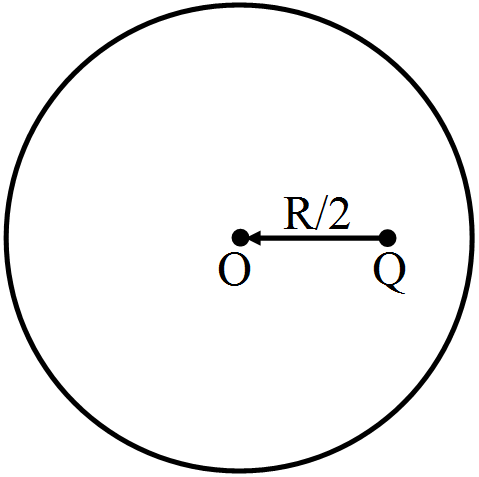
Figure shows a point charge +Q, located at a distance $\frac{\text{R}}{2}$ from the centre of a spherical metal shell. Draw the electric field lines for the given system.
The thermal energy developed in a current$-$carrying resistor is given by $U = i^2 Rt$ and also by $U = V$ it. Should we say that $U$ is proportional to $i^2$ or $i?$
Answer the following questions:
The charged currents in the outer conducting regions of the earth’s core are thought to be responsible for earth’s magnetism. What might be the ‘battery’ (i.e., the source of energy) to sustain these currents?
A sphere of radius $1.00\ cm$ is placed in the path of a parallel beam of light of large aperture. The intensity of the light is $0.5\ W/cm^{-2}.$ If the sphere completely absorbs the radiation falling on it, find the force exerted by the light beam on the sphere.
In what condition does a charged particle moving through a magnetic field follow a circular path?
An electron is moving a along +ve x-axis in the presence of uniform magnetic field along +ve y-axis. What is the direction of the force acting on it?
Drift velocity is inversely proportional to what? and it does not depend on what?