Question
What are cathode rays? How are these rays formed?
Answer

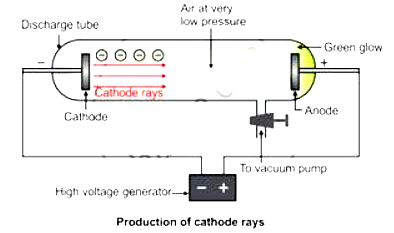
Cathode rays are the beam of electrons which travel from the negatively charged end (i.e. cathode to anode) of a vacuum tube, across a voltage difference between the electrodes placed at each end. Formation of cathode rays: Generally gases are poor conductors of electricity. However, when a high voltage charge from an induction coil is applied to tubes filled with gases at very low pressure (0.01 mm of mercury), the gases become good conductors of electricity and begin to flow in the form of rays. These rays are called cathode rays and they travel from the cathode towards the anode. 

Need a full question paper?

Generate a complete, print-ready paper with questions like this in minutes — across 16+ boards, with answer keys.

Start Generating Free

Similar questions

A certain amount of a gas occupies a volume of 0.4 litre at 17°C. To what temperature should it be heated so that its volume gets (a) doubled, (b) reduced to half, pressure remaining constant?
At constant temperature, the effect of change of pressure on the volume of a gas was as given below:
Pressure in atmosphere Volume in liters
$0.20$ $112$
$0.25$ $89.2$
$0.40$ $56.25$
$0.60$ $37.40$
$0.80$ $28.10$
$1.00$ $22.4$
(a) Plot the following graphs
  1. $P$ vs $V$
  2. $P$ vs $1/V$
  3. $PV$ vs $P$
Interpret each graph in terms of the law.
(b) Assuming that the pressure values given above are correct, find the correct measurement of the volume.
When hydrogen is passed over a black solid compound A, the products are a 'colorless liquid' and a 'reddish-brown metal B'.
Substance B is divided into two parts each placed in separate test tubes.
Dilute HCl is added to one part of substance B and dilute $HNO_3$ to the other.
  1. Name the substances A and B.
  2. Give two tests for the colourless liquid formed in the experiment.
  3. What happens to substance A when it reacts with hydrogen? Give reasons for your answer.
  4. Write an equation for the reaction between hydrogen and substance A.
  5. Is there any reaction between substance B and dilute hydrochloric acid? Give reasons for your answer.
How can you say these are chemical changes? Give one reason for your answer.
Consider the following elements: Be, Li, Na, Ca, K. Name the elements of (a) same group (b) same period.
Match the atomic numbers 4, 14, 8, 15 and 19 with each of the following:
  1. A solid non-metal of valency 3.
  2. A gas of valency 2.
  3. A metal of valency 1.
  4. A non-metal of valency 4.
The atomic number of an element is more important to the chemist than its relative atomic mass. Why?
Draw the orbital diagram of ${ }_{20}^{40} \mathrm{Ca}^{2+}$ ion and state the number of three fundamental particles present in it.
It is found that on heating a gas its volume increases by 50% and its pressure decreases to 60% of its original value. If the original temperature was-15°C, find the temperature to which it was heated.
Steam can react with metal and non-metal to liberate hydrogen. Give the necessary conditions and equations for the same.