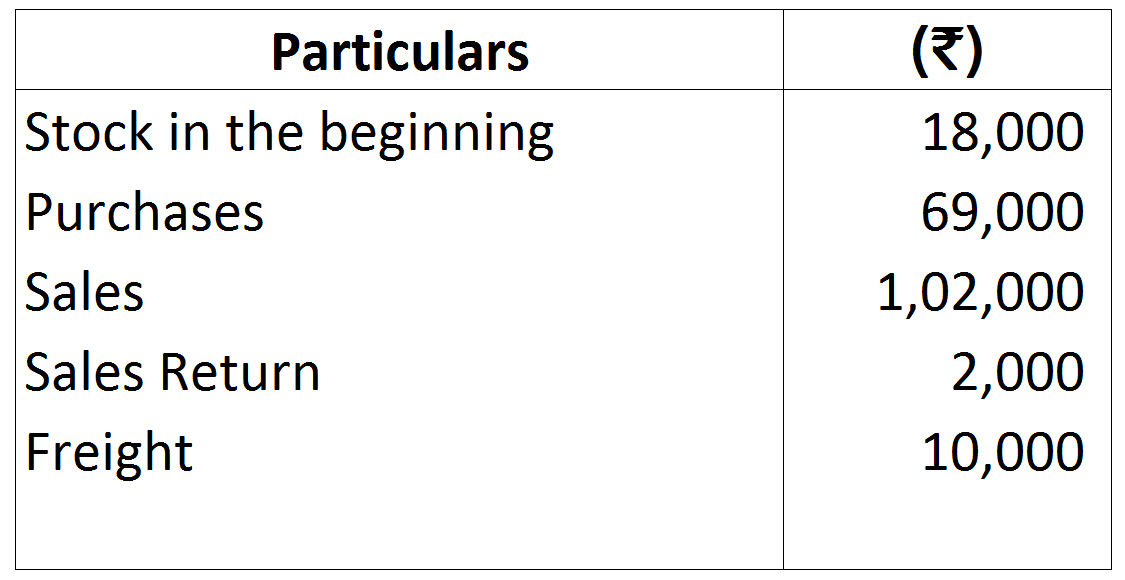
Question
What are Direct Expenses? Give two examples.

Answer

Direct Expenses: Direct Expenses are the expenses incurred on the goods purchased, till they are brought to the place of business. Examples of such expenses are freight inwards, insurance, customs (import) duty, clearing charges, cartage, loading and unloading charges, etc. In a manufacturing concern, besides the above, expenses incurred for purposes of production such as wages, power and fuel, factory rent, etc., are also Direct Expenses.
Examples:
  1. Carriage or Freight or Cartage Inwards: It is the cost of bringing materials to the firm's godown. If any freight or carriage is paid on any asset, like machinery, it is added to the cost of the asset and is not debited to Trading Account.
  2. Wages: Wages paid to workers in the factory, including stores, are debited to the Trading Account; if any amount is outstanding it is accounted for so that the total wages for the period are debited to Trading Account.

Need a full question paper?

Generate a complete, print-ready paper with questions like this in minutes — across 16+ boards, with answer keys.

Start Generating Free

Similar questions

Ram draws a bill for ₹ 2,000 on Shyam on 15th September, 2018 for 3 months. On maturity, Shyam failed to honour the bill.
Pass the necessary Journal entries in the books of Ram and Shyam.
Write short notes on the following:
  1. Customised Accounting Software;
  2. Readymade Accounting Software.
The following balances appeared in the trial balance of M/s Kapil Traders as on March 31, 2017
 
Sundry debtors
30,500
Bad debts
500
Provision for doubtful debts
2,000
The partners of the firm agreed to records the following adjustments in the books of the Firm: Further bad debts ₹ 300. Maintain provision for bad debts 10%. Show the following adjustments in the bad debts account, provision account, debtors account, profit and loss account and balance sheet.
From the following information, prepare Trading Account for the year ended $31^{st}$ March, $2019$:
Adjusted Purchases ₹ $6,60,000$; Sales ₹ $7,44,000$; Closing Stock ₹ $50,400$; Freight and Carriage Inwards ₹ $3,600$; Wages ₹ $6,000$; Freight and Cartage Outwards ₹ $2,000$.
Rectify the following errors by passing Journal entries:
  1. Old furniture sold for ₹ 500 has been credited to Sales Account.
  2. Machinery purchased on credit from Raman for ₹ 2,000 recorded through Purchases Book as ₹ 16,000.
  3. Cash received from Rajat ₹ 5,000 was posted to the debit of Bhagat as ₹ 6,000.
  4. Depreciation provided on machinery ₹ 3,000 was posted to Machinery Account as ₹ 300.
From the following balances extracted from the books of M/s Ahuja and Nanda. Calculate the amount of:
  1. Cost of goods available for sale.
  2. Cost of goods sold during the year.
  3. Gross Profit.
 
Opening stock. 25,000
Credit purchases 7,50,000
Cash purchases 3,00,000
Credit sales 12,00,000
Cash sales 4,00,000
Wages 1,00,000
Salaries 1,40,000
Closing stock 30,000
Sales return 50,000
Purchases return 10,000
State the relationship between information and decision.
Ascertain the value of Closing Stock from the following:
Rate of G.P. on cost is 25%.
What are the possible reasons for keeping incomplete records?
Why is Balance Sheet prepared?