Question
What are elastomers? Distinguish between thermoplastic polymers and thermosetting polymers.

Answer

Polymers having the property of elasticity in which a substance gets stretched by external force and restores its original shape on the release of that force are called elastomers.
Thermoplastic
Polymer
Thermosetting
Polymer
1. These are formed by addition polymerisation .These are formed by condensation polymerisation .
2. They have low molecular weight .They have high molecular weight.
3.They are usually soft ,weak and less brittle .hey are usually hard ,strong and more brittle
4. They are long chain linear polymer with negligible cross linksThey have three-dimensional network structure with number of crosslinks .
5. They are usually soluble in some organic solvents .Due to strong bonds and crosslinks ,they are insoluble in almost all organic solvents .
6. They get softened on reheating readily because secondary forces between the individual chain can break easily by heat or pressure .They donot soften on reheating because the crosslinks and bonds retain their strength on heating .
7.Example : Polyethylene ,Polystyrene ,PVC ,PVA .Example : Phenolformaldehyde,ureaformaldehyde , Nylon 6,6 .

Need a full question paper?

Generate a complete, print-ready paper with questions like this in minutes — across 16+ boards, with answer keys.
Start Generating Free

Similar questions

An unknown alcohol is treated with Lucas reagent. Explain how you will determine whether the alcohol is primary, secondary or tertiary. Indicate by chemical equation the reaction between isopropyl alcohol and Lucas reagent.
What is the value of $\Delta S _{\text {surr }}$ for the following reaction at $298 K$ ?
$6 CO _{2( g )}+6 H _2 O _{( l )} \longrightarrow C _6 H _{12} O _{6( s )}+6 O _{2( g )}$
Given that, $\Delta G^0=2879 \ kJ \ mol ^{-1} \Delta S=-210 \ J K ^{-1} \ mol ^{-1}$.
Calculate the equilibrium constant for the redox reaction at $25^{\circ} C$.
$Sr _{( s )}+ Mg ^{2+} \rightarrow Sr ^{2+}{ }_{( aq )}+ Mg _{( s ),}$
that occurs in a galvanic cell. Write the cell formula.
$E ^0 Mg =-2.37 V \text { and } E ^0 { }_{Sr }=-2.89 V \text {. }$
Calculate the standard enthalpy of the reaction, $2 C _{\text {(graphite) }}+3 H _{2( g )} \longrightarrow C _2 H _{6( g )} \quad ; \Delta H^0=$ ? from the following $\Delta H^0$ values:
(a) $C _2 H _{6( g )}+\frac{7}{2} O _{2( g )} \longrightarrow 2 CO _{2( g )}+3 H _2 O _{(l)} \quad ; \Delta H^0=-1560 kJ$
(b) $H _{2( g )}+\frac{1}{2} O _{2( g )} \longrightarrow H _2 O _{( l )}$$\text { ; } \Delta H^0=-285.8 kJ$
(c) $C _{\text {(graphite) }}+ O _{2( g )} \longrightarrow CO _{2( g )} \quad ; \Delta H^0=-393.5 kJ$
Give uses of $KMnO_4$
Explain the determination of molar conductivity of a weak electrolyte at infinite dilution or zero concentration using Kohlrausch’s law.
Define acids and bases according to Bronsted$-$Lowry theory. Derive relationship between $pH$ and $pOH.$
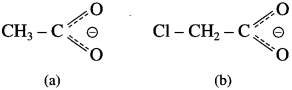
Compare the following two conjugate bases and answer.

Image
(1) Indicate the inductive effects of $CH_3$ – group in (a) and Cl-group in (b) by putting arrowheads in the middle of appropriate covalent bonds.
(2) Which species is stabilized by inductive effect, (a) or (b) ?
(3) Which species is destabilized by inductive effect, (a) or (b) ?
What are the high-spin and low-spin complexes?
What is the molar mass of a solute if a solution prepared by dissolving $0.822 g$ of it in $0.3 \ dm^3$ of water has an osmotic pressure of $0.196 \ atm.$ at $298 K$?