Question
What are hallucinogens? Give two examples. Mention their clinical use, if
any.

Answer

Hallucinogens are a diverse group of drugs that alter a person’s awareness of their surroundings as well as their own thoughts and feelings.
LSD (lysergic acid diethyl amide) is a synthetic compound and one of the most powerful hallucinogens. It's typically delivered on a small piece of paper that the user puts into his or her mouth. LSD can cause a person to focus on small details, like the pores of their skin, or see objects in brilliant color. LSD can also prompt strong moods swings that range from joy to depression. An LSD trip can last up to 10 hours, during which time the person can experience impaired judgment and hallucinatory-like experiences. Though LSD is not considered to be addictive like cocaine and heroin, you can build up a tolerance that requires using more of the substance in order to get the same high.
Need a full question paper?

Generate a complete, print-ready paper with questions like this in minutes — across 16+ boards, with answer keys.

Start Generating Free

Similar questions

Explain the process of fertilisation in human female, and trace the postfertilisation events in a sequential order up to implantation of the embryo.

OR

Explain the process of fertilisation and implantation in humans.

During the course of evolution why DNA was chosen over RNA as genetic material? Give reasons by first discussing the desired criteria in a molecule that can act as genetic material and in the light of biochemical differences between DNA and RNA.
Explain any three preventive measures to control microbial infections.
Transcription in eukaryotes is more complex process than in prokaryotes. Justify and compare the initiation, elongation and termination in bacterial cells with eukaryotes.
Which of the following ecosystems will be more productive in terms of primary productivity? Justify your answer.
A young forest, a natural old forest, a shallow polluted lake, alpine meadow.
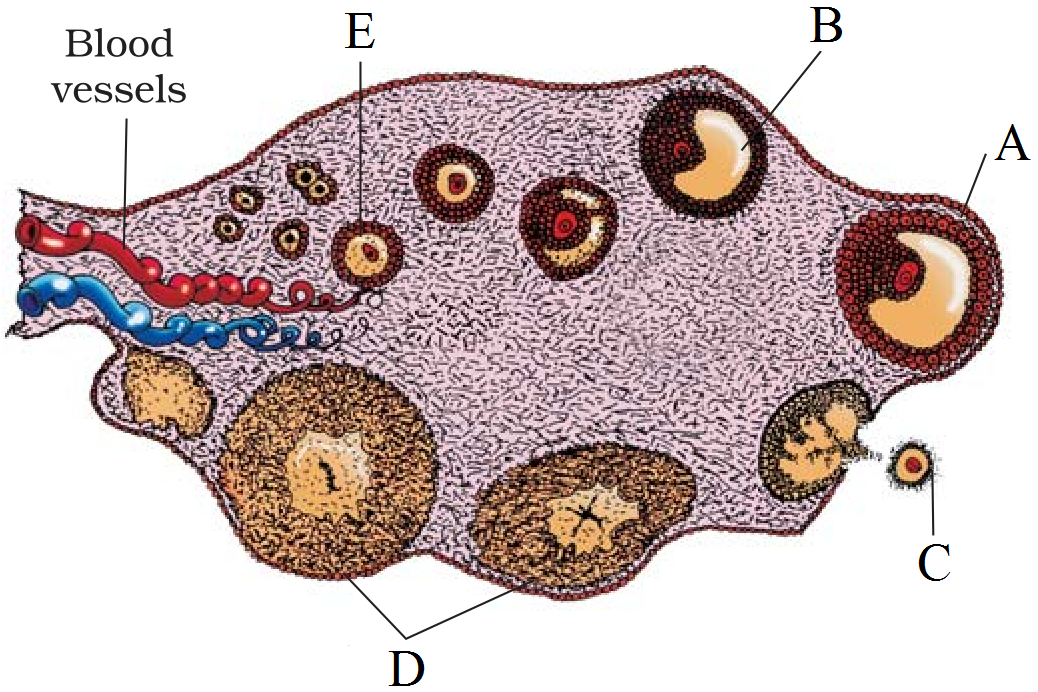
  1. Given below is the TS of human ovary. Identify the following in the diagram:
  • Corpus luteum.
  • Secondary oocyte.
  • Antrum.
  • Primary follicle.
  • Primary oocyte.
  1. Explain the changes the primary oocyte undergoes while in different follicular stages before ovulation.

​​​​​​​

List the attributes that populations but not individuals possess.
Answer the following questions:
Draw a schematic diagram of a human sperm and label the cellular components. Give the functions of any three parts.
Differentiate between:
a. hypocotyol and epicotyl
b. coleoptile and coleorrhiza
c. integument and testa
d. perisperm and pericarp
Describe the law of independent by using punnet's square.