Question
What are solutions? How are these helpful in medicinal formulations?

Answer

Solutions refer to the presence of dissolved substances in solvents, mostly water. We can have a dilute solution or a concentrated solution. These are comparative terms. A dilute solution can be a small amount of dissolved substance, and a concentrated solution contains a higher amount of dissolved substances. We can also have an unsaturated solution and a saturated solution. A saturated solution has the maximum amount of solute dissolved at a fixed temperature. But an unsaturated solution can have more solute dissolved at a given temperature.
A saturated solution becomes unsaturated at higher temperatures. Conversely, an unsaturated solution becomes saturated at a lower temperature. For medicinal formulations, only dilute solutions are used. Generally, drug formulations are prepared using water as a solvent. The Indian system of medicine also refers to the use of oil, ghee, milk, and other substances as solvents for drug formulations to achieve the beneficial strength of the drug. In some cases, some solvents are used to extract and isolate important compounds from plants. Asima Chatterjee was given the Shanti Swarup Bhatnagar Award for her work on the isolation of important medicinal compounds from plants.

Need a full question paper?

Generate a complete, print-ready paper with questions like this in minutes — across 16+ boards, with answer keys.

Start Generating Free

Similar questions

I wonder what makes the Earth unique for living beings to grow and survive!
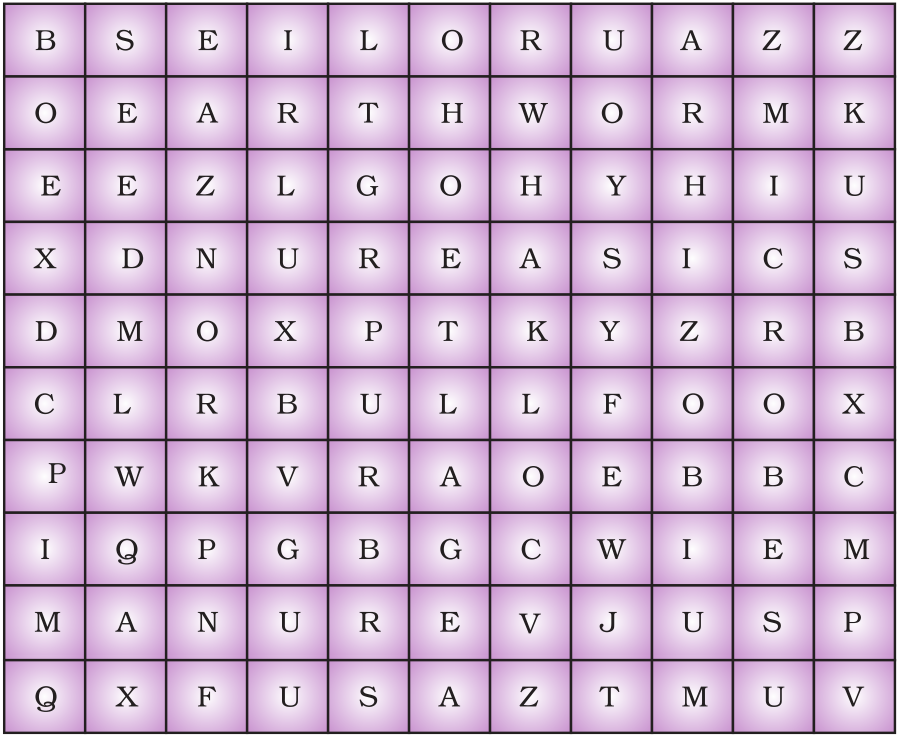
From the word puzzle given as Fig. find atleast eight words which are ‘farmer’s friends.’ Classify them into living and non living.
Classify the following as elements, compounds, or mixtures in the Table.
Carbon dioxide, sand, seawater, magnesium oxide, muddy water, aluminum, gold, oxygen, rust, iron sulfide, glucose, air, water, fruit juice, nitrogen, sodium chloride, sulfur, hydrogen, and baking soda.
Image
Identify pure substances amongst these and list them below.

Image
Given below is a conversation between two farmers Heera and Beera.
Heera: Brother Beera, your maize crops looks beautiful! They have grown pretty fast.
Beera: Yes, I have sprayed urea this time. What about you?
Heera: Well, I am still relying on good old cow dung. I am saving money for buying a tractor.
Beera: That’s good. Tractor saves a lot of time and labour.
Heera: Yes, it’s been very labour intensive for me and now these weeds have come up.
Beera: Try weedicides, they are very effective. Now answer the following questions.
$i.$ List the practices which are not environment friendly and why?
$ii.$ What is the advantage of modern agriculture implements over traditional ones?
$iii.$ Name one weedicide and the precaution farmers must take during its application.
Write a short note on petroleum.
Describe female reproductive organs with the help of a labelled diagram.
Write a short paragraph on the harmful effects of microorganisms.
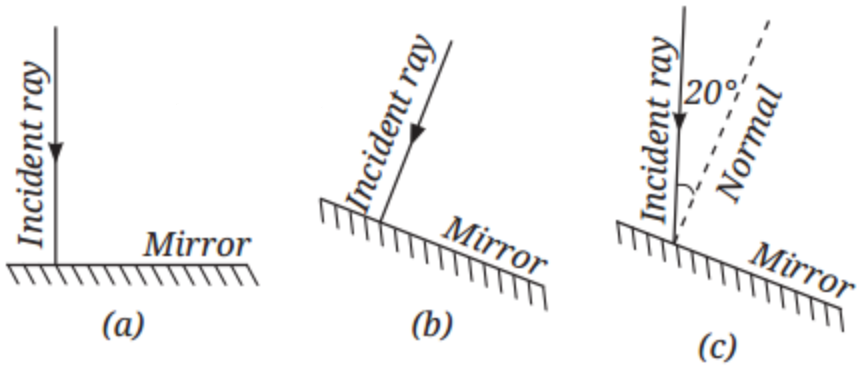
The figure shows three different situations where a light ray falls on a mirror:
Image
1. The light ray falls along the normal.
2. The mirror is tilted, but the light ray still falls along the normal to the tilted surface.
3. The mirror is tilted, and the light ray falls at an angle of 20° from the normal.
Draw the reflected ray in each case (Use a ruler and protractor for accurate drawing). What is the angle of reflection in each case?

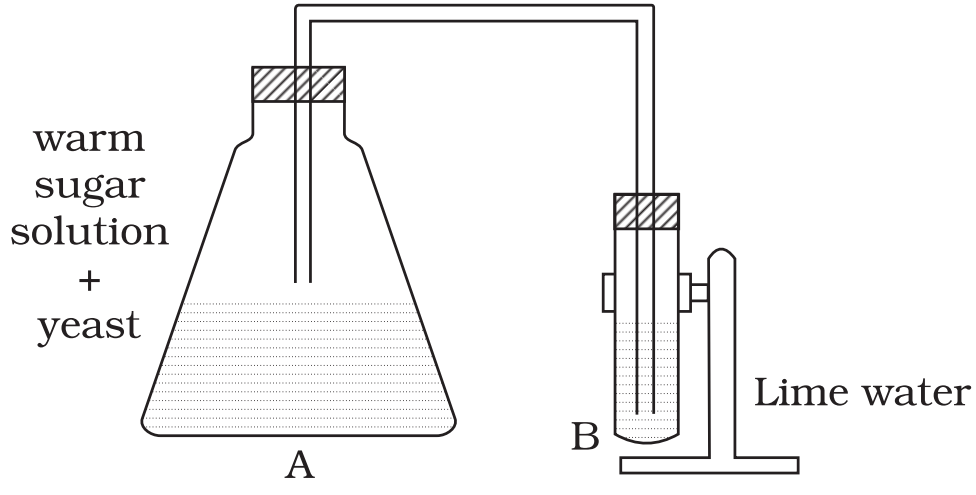
Observe the set up given in Fig and answer the following questions.
$a.$ What happens to the sugar solution in $A?$
$b.$ Which gas is released in $A?$
$c.$ What changes will you observe in $B$ when the released gas passes through it?
Mention any three ways through which pathogens are transmitted.