Question
What are some features of $p-$type semiconductors?

Answer

$1.$ These are materials doped with trivalent impurity atoms $($acceptors$).$
$2.$ Electrical conduction in these materials is due to majority charge carriers i.e., holes.
$3.$ The acceptor atoms acquire electron and become negatively charged$-$ions.
$4.$ Number of holes is very large compared to the number of free electrons. $n_h >> n_e.$ Holes are majority charge carriers.
$5.$ When energy is supplied externally, positively charged holes $($majority charge carriers$)$ and negatively charged free electrons $($minority charge carriers$)$ are available for conduction.

Need a full question paper?

Generate a complete, print-ready paper with questions like this in minutes — across 16+ boards, with answer keys.
Start Generating Free

Similar questions

How much positive and negative charge is present in $1 g$ of water? How many electrons are present in it?
$($Given: molecular mass of water is $18.0 g)$
DC current flows in a metal piece of non uniform cross-section. Which of these quantities remains constant along the conductor: current, current density or drift speed?
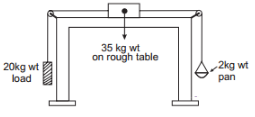
Figure below shows a block of mass $35\ kg$ resting on a table. The table is so rough that it offers a self adjusting resistive force $10 \%$ of the weight of the block for its sliding motion along the table. A $20\ kg$ wt load is attached to the block and is passed over a pulley to hang freely on the left side. On the right side there is a $2\ kg$ wt pan attached to the block and hung freely. Weights of $1\ kg$ wt each, can be added to the pan. Minimum how many and maximum how many such weights can be added into the pan so that the block does not slide along the table? [Ans: Min $15$, maximum $21$].
Image
Explain the term: Displacement.
If relative permittivity of water is $80$ then derive the relation between $F _{\text {water }}$ and $F _{\text {vacuum }}$. What can be concluded from it?
A bullet of mass $m1$ travelling with a velocity u strikes a stationary wooden block of mass $m2$ and gets embedded into it. Determine the expression for loss in the kinetic energy of the system. Is this violating the principle of conservation of energy? If not, how can you account for this loss?
Define absolute error, mean absolute error, relative error and percentage error.
State the characteristics of centre of mass.
Find the number of significant figures in the following numbers,
i. 25.42
ii. 0.004567
iii. 35.320
iv. 91.000
Suppose that the electric field amplitude of an electromagnetic wave is $E_0=120 N / C$ and that its frequency is $v=50.0 MHz. (i)$ Determine, $B_0, \omega, k$, and $\lambda. (ii)$ Find expressions for $\vec{E}$ and $\vec{B}$.