Question
What are standing waves? Discuss graphical method for formation of standing waves on stretched strings.

Answer

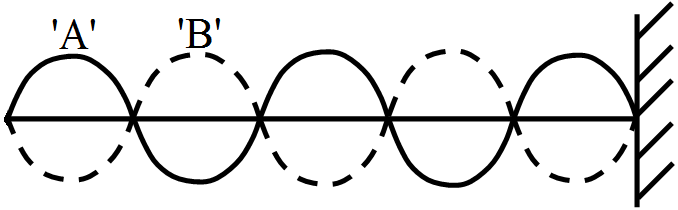
Standing waves are the pattern of waves produced when two waves moving in opposite direction interact. They do not transport energy.

If a wave ‘A’ is made to hit a rigid support, there will be a reflected wave 'B' from the rigid support. As the two waves are super imposed, there will be a standing wave (as shown) produced.
It can be represented by the equation, $\text{y}=2\text{A}\sin\text{kx}\cos\omega\text{t}$indicating a position varying amplitude $(2\text{A}\sin\text{kx})$

Need a full question paper?

Generate a complete, print-ready paper with questions like this in minutes — across 16+ boards, with answer keys.
Start Generating Free

Similar questions

Consider a sunlike star at a distance of 2 parsecs. When it is seen through a telescope with 100 magnification, what should be the angular size of the star? Sun appears to be $\Big(\frac{1}{2}\Big)^0$ from the earth. Due to atmospheric fluctuations, eye can’t resolve objects smaller than 1 arc minute.
The maximum tension in the string of an oscillating pendulum is double of the minimum tension. Find the angular amplitude.
A function $\text{f}(\theta)$ is defined as:$\text{f}(\theta)=1-\theta+\frac{\theta^2}{2!}-\frac{\theta^3}{3!}+\frac{\theta^4}{4!}$
Why is it necessary for q to be a dimensionless quantity?
Can an electromagnetic wave be deflected by an electric field or a magnetic field?
A circular ring of radius r made of a nonconducting material is placed with its axis parallel to a uniform electric field. The ring is rotated about a diameter through 180°. Does the flux of electric field change? If yes, does it decrease or increase?
If the unit of force is 100N, unit of length is 10m and unit of time is 100s, what is the unit of mass in this system of units?
Two vessels $A$ and $B$ of different materials but having identical shape, size and wall thickness are filled with ice and kept at the same place. Ice melts at the rate of $100 \mathrm{~g} \mathrm{~min}^{-1}$ and $150 \mathrm{~g} \mathrm{~min}^{-1}$ in $A$ and $B$, respectively. Assuming that heat enters the vessels through the walls only, calculate the ratio of thermal conductivities of their materials.
A plate of area $10cm^2$ is to be electroplated with copper (density $9000kg/m^3$) to a thickness of 10 micrometres on both sides, using a cell of 12V. Calculate the energy spent by the cell in the process of deposition. If this energy is used to heat 100g of water, calculate the rise in the temperature of the water. ECE of copper = $3 \times 10^{-7}kg C^{-1}$ and specific heat capacity of water = $4200Jkg^{-1}$.
The flow rate of water is $0.58 L / mm$ from a tap of diameter of 1.30 cm . After some time, the flow rate is increased to $4 L / min$. Determine the nature of the flow for both the flow rates. The coefficient of viscosity of water is $10^{-3} Pa- s$ and the density of water is $10^3 kg / m ^3$.
When $1.0 \times 10^{12}$ electrons are transferred from one conductor to another, a potential difference of 10V appears between the conductors. Calculate the capacitance of the two-conductor system.