Question
What are the $a-$amino acids?
Answer

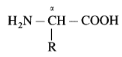
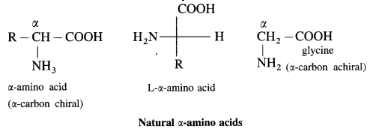
$\alpha$-Amino acids are carboxylic acids having an amino $\left(NH _2\right)$ group bonded to the $\alpha-$carbon, i.e. the carbon next to the carboxyl $(COOH )$ group.
Image
$\alpha-$amino acids are derivatives of carboxylic acids, obtained by replacing $- H$ atom by amino group.
They are bifunctional compounds containing acidic Image and basic $NH_2$ groups.
Example : Image $($where $R$ is an alkyl group or aryl group$).$
The amino acids are colourless, crystalline, water soluble, high melting solids. These acids in their
aqueous solutions behave like salts due to presence of both acidic, Image and basic. $(NH_2)$ groups in the same molecule.
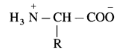
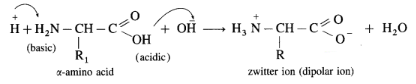
Such a doubly charged ion is known as zwitter ion. Example : Image
Image

Need a full question paper?

Generate a complete, print-ready paper with questions like this in minutes — across 16+ boards, with answer keys.

Start Generating Free

Similar questions

How will you bring about the following conversions?
acetone to 2-methylpropan-2-ol
How is acid amide obtained from carboxylic acid?
Calculate heat of formation of pentane from the following data :
(i) $C _{( s )}+ O _{2( g )}= CO _{2( g )} \Delta H ^0=-393.51 kJ$
(ii) $H _{2( g )}+12 O _{2( g )}= H _2 O _{( I )} \Delta H ^0=-285.80 kJ$
(iii) $C _5 H _{12}+{ }_{2( g )}=5 CO _{2( g )}+6 H _2 O _1 \Delta H ^0=-3537 kJ$
Mention the factors on which the colour of a transition metal ion depends.
Write two applications of electrochemical series.

Classify the following alcohols as l0/2°/3° and allylic/benzylic
Image
Heat of fusion of ice at $0^{\circ} C$ and 1 atmosphere is $6.1 kJ mol ^{-1}$ and heat of evaporation of water at $100^{\circ} C$ is $40.7 kJ mol ^{-1}$. Calculate the enthalpy change for the conversion of 1 mole of ice at $0^{\circ} C$ into vapour at $100^{\circ} C$. Heat capacity of water is $4.184 JK ^{-1} mol ^{-1}$.
Give the main difference between electrolytic conductivity and molar conductivity with respect to concentration. Also write one application of electrochemical series.
The dissociation constant of a weak monoacidic base is $1.2 \times 10^{-5}$ at $25^{\circ} C$. The molar conductivity of the base at zero concentration is $354.8 \Omega^{-1} cm ^2 mol ^{-1}$ at $25^{\circ} C$. Calculate the percentage dissociation and molar conductivity of the weak base at $0.1 M$ concentration.
Why is molecularity applicable for only elementary reactions whereas order of a reaction is applicable for elementary and complex reactions? Explain with suitable examples.