Question
What are the advantages of having a nervous system?

Answer

The advantages of having a nervous system are as follows:
(a) Keeps us informed about the outside world through sense organs.
(b) Enables us to remember, think and reason out.
(c) Controls and harmonizes all voluntary muscular activities such as running, holding, writing
(d) Regulates involuntary activities such as breathing, beating of the heart without our thinking about them.

Need a full question paper?

Generate a complete, print-ready paper with questions like this in minutes — across 16+ boards, with answer keys.

Start Generating Free

Similar questions

Draw a well-labelled diagram of the vertical section of mammalian brain.
Give Reasons for the following:
Guard cells are small in size and are kidney-shaped in outline.
Label the following diagram :
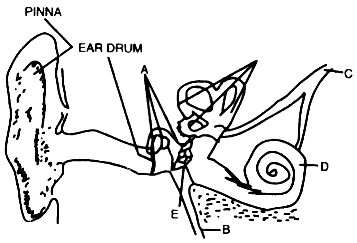
Given below is the diagram of the human ear. Study the same and answer the questions that follow:
(i) Give the biological term for the part labeled ‘A’ and state its function.
(ii) Name the part labeled ‘B’ and state its function.
(iii) Name the part labeled ‘C’ and state its function.
(iv) Give the function of ear wax.
A candidate in order to study the process of osmosis has taken 3 potato cubes and put them in 3 different beakers containing 3 different solutions. After 24 hours, in the first beaker the potato cube increased in size, in the second beaker the potato cube decreased in size and in the third beaker there was no change in the size of the potato cube. The following diagram shows the result of the same experiment:
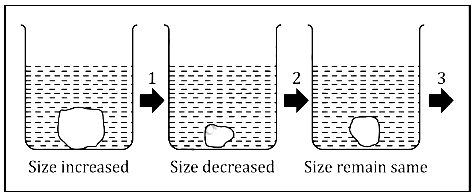
(i) Give the technical terms of the solutions used in beakers, 1, 2 and 3.
(ii) In beaker 3, the size of the potato cube remains the same. Explain the reason in brief.
(iii) Write the specific feature of the cell sap of root hairs which helps in absorption of water.
(iv) What is osmosis?
(v) How does a cell wall and a cell membrane differ in their permeability?
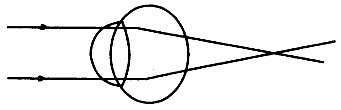
Given below is a diagrammatic representation of a defect of the human eye:

(i) Identify the defect.
(ii) Mention two reasons for the above defect.
(iii) State how the defect can be rectified.
(iv) Name the part of the eye responsible for maintaining the shape of the eyeball.
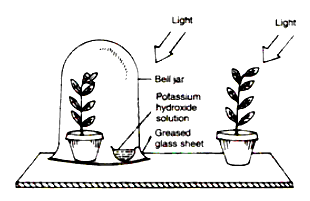
Two healthy green plants were placed in the dark for $24$ hours. They were then set up, as shown in the figure, for $4$ hours. Then a leaf was taken from each plant and
the chlorophyll was removed from the leaves:
( i) What is the next and final step in this experiment?
( ii ) What would be the results of the final step?
( iii ) Why was it necessary to grease the glass sheet?
( iv ) What hypothesis is being tested in this experiment?
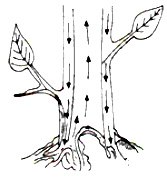
The figure shows a diagrammatic representation of the movement of certain substances inside the stem of a certain plant. Write five sentences on whatever you can explain about the processes or the arrangement of structures indicated in the diagram.
Note: - Each sentence must include one or more of the following four words, and each word can be used several times. Xylem, phloem, roots, leaves.
Differentiation between:
Transpiration and guttation
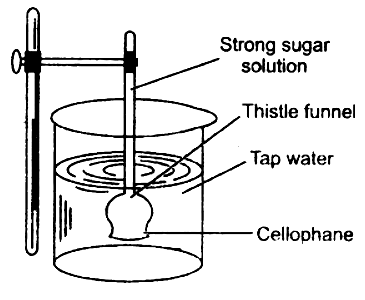
The diagram below represents an experimental set up to demonstrate a vital process. Study the same and then answer the questions that follow:


(i) Name the process.
(ii) Define the above named process.
(iii) What would you observe in the experimental setup after an hour or so?
(iv) What control experiment can be set up for the above experiment?
(v) Keeping in mind the root hair cell and its surrounding name the part that corresponds to (1) Concentrated sugar solution, (2) Parchment paper, (3) Water in the beaker.
(vi) Name any other substance that can be used instead of parchment paper in the above experiment.
(vii) Mention two advantages of this process to the plant.