Question
What are the advantages of the periodic table?

Answer

Advantages of the periodic table:
  1. It has made the study of chemistry systematic and easy.
  2. It is easier to remember the properties of an element if its position in the periodic table is known.
  3. The type of compounds formed by an element can be predicted by knowing its position in the periodic table.
  4. It is used as a teaching aid in chemistry in schools and colleges.

Need a full question paper?

Generate a complete, print-ready paper with questions like this in minutes — across 16+ boards, with answer keys.
Start Generating Free

Similar questions

Complete the following chart with reference to pre-disaster management.
A, B and C are three common STDs. A and C are caused by bacteria whereas B is caused by a virus D. The virus D reduces the immunity of the infected person to such a low level that the person can die of even very mild diseases.
  1. What could A and C be?
  2. What is B?
  3. Name the virus D?
  4. How can A, B and C be caused?
  5. Out of A, B and C, which one does not have a definite cure as yet?
There are four organisms A, B, C and D. The organism A eats only the flesh of other animals as food. The organism B can eat grains, fruits and vegetables as well as meat and fish. The organism C can make the food itself from simple inorganic substances present in the environment by utilising sunlight energy. On the other hand, organism D eats only plants and their products as food.
  1. Which organism is
  1. Omnivore,
  2. Herbivore,
  3. Carnivore?
  1. Which organism is an autotroph?
  2. Which organism is/ are heterotroph (s)?
  3. Which organism can be a producer?
  4. Which organism is/ are consumer (s)?
Give one example each of organisms which could be like A, B, C and D.
(i) Determine the SI unit of the universal constant of gravitation from the formula for the gravitational force between two particles. Hence, state the CGS unit of the constant of gravitation. (ii) Define G (universal gravitational constant)
 Explain the importance of good communication with others.
There are four tiny organisms A, B, C and D. The organism A is a parasitic protozoan which causes a disease known as kala-azar. The organism B is a microscopic single-celled animal which causes malaria disease in human beings. The organism C is a unicellular animal which can change its body shape according to need, it has no fixed shape. The organism D is also a unicellular animal which is slipper-shaped having a large number of tiny hair all around its body.
  1. Name the organisms A, B, C and D.
  2. Name one characteristic body feature of organism A.
  3. Name the insect which carries organism B and transmits it from one person to another.
  4. What name is given to the asexual method of reproduction of (i) organism A, and (ii) organism B?
  5. Where do organisms C and D live?
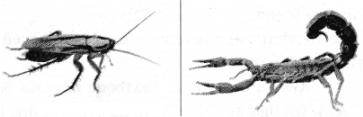
Observe the figures given below and answer the given questions:
Image
(a) In which phylum are these animals included?
(b) Which substance forms the outer layer of their exoskeleton?
(c) What are their locomotory organs?
In the above circuit, if the resistor is replaced by a motor, in which form will the energy given by the cell get transformed into?
Source Microbe Amino acid Use
Sugar and beet molasses, ammonia salt ___________________ ___________________ Production of monosodium glutamate (Ajinomoto).
___________________ Aspergillus niger ___________________ Drinks, toffees, chocolate production.
Glucose, corn steep liquor ___________________ Gluconic acid ___________________
Molasses, corn steep liquor Lactobacillus delbrueckii ___________________ ___________________
___________________ Aspergillus itaconius Itaconic acid ___________________
Explain the meanings of the following symbols:
Image