Question
What are the changes force can bring on a body?

Answer

Force can change the magnitude of speed, the direction of motion and the shape of the body.

Need a full question paper?

Generate a complete, print-ready paper with questions like this in minutes — across 16+ boards, with answer keys.

Start Generating Free

Similar questions

A closed organ pipe can vibrate at a minimum frequency of 500Hz. Find the length of the tube. Speed of sound in air = 340m/s.
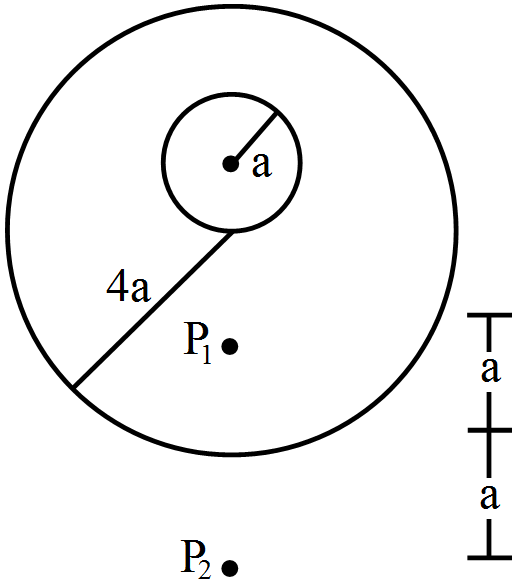
A uniform metal sphere of radius a and mass M is surrounded by a thin uniform spherical shell of equal mass and radius 4a The centre of the shell falls on the surface of the inner sphere. Find the gravitational field at the points P1 and P2 shown in the figure.

An unruly demonstrator lifts a stone of mass 200g from the ground and throws it at his opponent. At the time of projection, the stone is 150cm above the ground and has a speed of 3.00m/s. Calculate the work done by the demonstrator during the process. If it takes one second for the demonstrator to lift the stone and throw, what horsepower does he use?
A glass contains some water at room temperature 20°C. Refrigerated water is added to it slowly. When the temperature of the glass reaches 10°C, small droplets condense on the outer surface. Calculate the relative humidity in the room. The boiling point of water at a pressure of 17.5mm of mercury is 20°C and at 8.9mm of mercury it is 10°c.
Determine the speed with which the earth would have to rotate on its axis so that a person on the equator would weigh 3/5th as much as at present. Take the equatorial radius as 6400km.
A bob of mass 0.1 kg hung from the ceilling of a room by a string 2 m long is set into oscillation. The speed of the bob at its mean position is $1 m s ^{-1}$. What is the trajectory of the bob if the string is cut when the bob is (a) at one of its extreme positions, (b) at its mean position.
Obtain $\omega=\omega_0+\alpha t$ from first principles.
A satellite does not need any fuel to circle around the earth. Why?
In Exercise, let us take the position of mass when the spring is unstreched as x = 0, and the direction from left to right as the positive direction of x-axis. Give x as a function of time t for the oscillating mass if at the moment we start the stopwatch (t = 0), the mass is:
At the mean position.
In what way do these functions for SHM differ from each other, in frequency, in amplitude or the initial phase?
A 2 kg block is kept at rest on a flat surface. A horizontal force $F$ on the block is gradually increased. When the value of $F$ becomes 8 N the block starts moving. Once the motion starts, it starts moving at a uniform speed only with the help of 7N force. Find out :
(i) Static and dynamic friction coefficient.
(ii) When the value of $F$ is 5 N , then the static friction force acting on the block is.
(iii) When the value of $F$ is again 8 N the acceleration of moving block. ( $g = 9 . 8 ~ m / s ^2$ )