Question
What are the conventions used in writing a chemical equation?

Answer

Conventions used in writing a chemical equation:
(1) The reactants are written on the left hand side (LHS), while the products are written on the right hand side (RHS).
(2) Whenever there are two or more reactants, a plus sign (+) is written between each two of them. Similarly, if there are two or more products, a plus sign is written between each two of them.
(3) Reactant side and product side are connected with an arrow $\rightarrow$ ) pointing from reactants to products. The arrow represents the direction of the reaction. Heat is to be given from outside to the reaction, it is indicated by the sign $\Delta$ written above the arrow.
(4) The conditions like temperature, pressure, catalyst, etc., are mentioned above the arrow
$(\rightarrow)$ pointing towards the product side.

(5) The physical states of the reactants and products are also mentioned in a chemical equation. The notations $g, l , s$, and aq are written in brackets as a subscript along with the symbols / formulae of reactants and products. The symbols $g , l , s$, and aq stand for gaseous, 1iquid. solid and aqueous respectively.

If the product is gaseous, instead of $( g )$ it can be indicated by an arrow $\uparrow$ pointing upwards. If the product formed is insoluble solid, then instead of (s) it can be indicated by an arrow $\downarrow$ pointing downwards.
(6) Special information or names of reactants/products are written below their formulae.

Need a full question paper?

Generate a complete, print-ready paper with questions like this in minutes — across 16+ boards, with answer keys.
Start Generating Free

Similar questions

A part of the early classification of elements has been given below:
$\text{H}\ \ \ \ \ \ \ \text{Li} \ \ \ \ \ \ \ \text{Be} \ \ \ \ \ \ \ \ \ \text{B}\ \ \ \ \ \ \ \text{C}\ \ \ \ \ \ \ \text{N}\ \ \ \ \ \ \ \text{O}\\\text{F}\ \ \ \ \ \ \ \text{Na}\ \ \ \ \ \ \text{Mg}\ \ \ \ \ \ \ \text{Al}\ \ \ \ \ \ \text{Si}\ \ \ \ \ \ \ \text{P}\ \ \ \ \ \ \ \ \text{S}$
  1. Which law of classification of element is illustrated by the above arrangement of elements?
  2. Name the scientist who proposed such a classification of elements.
  3. Why is such a classification of elements compared with a characteristics of musical scale?
  4. State one limitation of this classification of elements.
Write short notes on the following: Tinning.
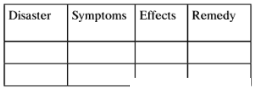
Complete the following chart with reference to pre-disaster management.
Read the passage and answer the questions based on it.
If heat is exchanged between a hot and cold object, the temperature of the cold object goes on increasing due to gain of energy and the temperature of the hot object goes on decreasing due to loss of energy. The change in temperature continues till the temperatures of both objects attain the same value. In this process, the cold object gains heat energy and the hot object loses heat energy. If the system of both the objects is isolated from the environment by keeping it inside a heat-resistant box then no energy can flow from inside the box or come into the box. In this situation, we get the following principle.
Heat energy lost by the hot object = Heat energy gained by the cold object. This is called the ‘Principle of heat exchange’.
  1. Where does heat transfer take place?
  2. In such a situation which principle of heat do you perceive?
  3. How can this principle be explained in short?
  4. Which property of the substance is measured using this principle?
Write short notes: Embryology.
Sketch, labell and classify: Wall Lizard
What are macromolecules? Explain Natural and manmade macromolecule.
Into which phyla is Non-chordata divided? In which three subphyla are Chordates divided?
Image
The gland X which is located just below the brain in the human head secretes a chemical substance Y which controls the development of ones and muscles in the body of a person. Secretion of too little of substance Y as well as the secretion of too much of substance Y by the gland X leads to abnormal development of the body of a person.
  1. Name the gland X.
  2. What is the chemical substance Y?
  3. What happens if too little of substance Y is secreted?
  4. What happens if too much of substance Y is secreted?
  5. Name the system of glands in the human body of which gland X is a part.