Question
What are the different classes of errors? Which of them do not affect a Trial Balance?

Answer

Keeping in view their nature, errors can be classified into following four categories:
  1. Errors of Omission.
  2. Errors of Commission.
  3. Errors of Principle.
  4. Compensating Errors.
Errors not affecting the Trial Balance or Two-sided Errors are those errors which do not affect the agreement of Trial Balance. Such errors are not disclosed by the Trial Balance. Following are the examples of such errors:
  1. Errors of Principle, i.e., errors which arise due to incorrect application of principles of accounting. Suppose on purchase of a typewriter or printer, Office Expenses Account is debited, Trial Balance will still match.
  2. Compensating Errors: If the effect of one error is cancelled by the effect of some other error or errors, Trial Balance will still match. Suppose, an amount of ₹ 10 received from A is not credited to his account and the total of the Sales Book is ₹ 10 in excess, the omission of credit to A's Account will be made up by the increased credit to the Sales Account; the Trial Balance will still match.
  3. Errors of complete omission.
  4. Posting correct amount on the correct side but in wrong account.
  5. Recording wrong amount in the books of original entry (but the recorded amount is correctly debited and credited).
  6. Recording both aspects of a transaction twice in the books of account.

Need a full question paper?

Generate a complete, print-ready paper with questions like this in minutes — across 16+ boards, with answer keys.

Start Generating Free

Similar questions

“A Computer system is capable of performing many things." Explain some of the capabilities of a Computer system. Capabilities of a Computer system.
Enter the following transactions in Two-column Cash Book of Gaurav, Delhi:
2019  
April 1 Opening Balance of Cash in Hand 1,00,000
  Opening Balance of Bank Overdraft 5,00,000
April 2 Sold goods for cash, including CGST and SGST @ 6% each 4,48,000
April 3 Sold goods including CGST and SGST @ 6% each against cheque and paid into bank the same day 3,36,000
April 5 Sold goods to Reema, including IGST @ 12% 1,12,000
April 6 Ram paid by cheque 78,000
  Discount allowed 2,000
April 7 Bought goods from Rahul, Gurugram for ₹ 40,000 plus CGST and SGST @ 6% each and paid him by cheque 44,800
  Salary paid to staff by cheque 2,20,000
April 10 Deposited into bank 3,10,000
April 11 Received a cheque from Suresh and paid into bank 1,28,500
  Discount allowed 1,500
April 15 Received from R. Kumar a cheque for a full settlement of his account for ₹ 1,95,000 1,87,500
April 18 Paid wages in cash 30,000
April 20 Bank charges, including CGST and SGST @ 6% each 5,600
April 22 Withdrew from bank for office use 1,00,000
  Withdrew from Bank for personal use 1,20,000
April 25 Paid electricity bill by cheque 31,500
  Issued a cheque in favour of Sudha as advance for purchase of house of Gaurav 2,00,000
April 26 Received a cheque from Amar 58,200
  Allowed discount to him 1,800
April 28 Cheque received from Amar sent to bank  
April 30 Bank collected interest received on investments 15,000
  Paid rent for the month of May, 2019, including CGST and SGST @ 6% each 22,400
Gopal does not keep proper books of account. Following information is given below:
  April 01, 2016 March 31, 2017
 
Cash in hand 18,000 12,000
Cash at bank 1500 2000
Stock in trade 80,000 90,000
Sundry debtors 36000 60,000
Sundry creditors 60,000 40,000
Loan 10,000 8,000
Office equipments 25,000 30,000
Land and Buildings 30,000 20,000
Furniture 10,000 10,000
During the year he introduced 20,000 and withdrew 12,000 from the business. Prepare the statement of profit or loss on the basis of given information.
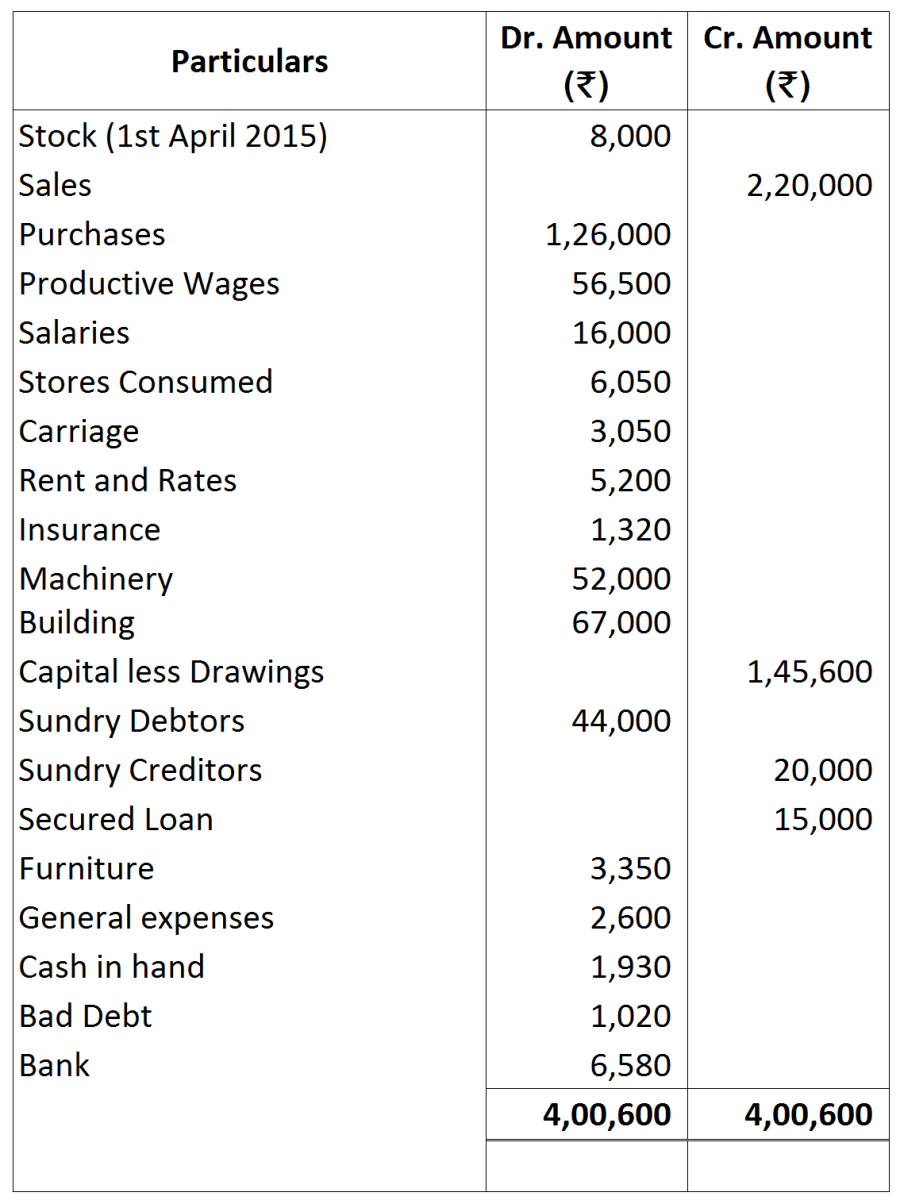
Following is the Trial Balance as on 31st March 2016. Prepare Trading and Profit and Loss Account and Balance Sheet:

Additional Information:
  1. Stock on 31st March 2016 is ₹ 20,600.
  2. Depreciate machinery @ 10% p.a.
  3. Make a Provision @ 5% for Doubtful Debts.
  4. Provide $2\frac{1}{2}\%$ for discount on sundry debtors.
  5. Rent and Rates include security deposit of ₹ 400.
  6. Insurance prepaid ₹ 120.
On 1st July, 2016, Sohan Lal & Sons purchased a plant costing ₹ 60,000. Additonal plant was purchased on 1st January, 2017 for ₹ 40,000 and on 1st October, 2017, for ₹ 20,000, plus CGST and SGST @ 6% each. On 1st April, 2018, one-third of the plant purchased on 1st July, 2016, was found to have become obsolete and was sold for ₹ 6,000, charging CGST and SGST @ 6% each.
Prepare the Plant Account for the first three years in the books of Sohan Lal & Sons. Depreciation is charged @ 10% p.a. on Straight Line Method. Accounts are closed on 31st March each year.
Ram Prashad keeps his books on Single Entry System and from them and the particulars supplied, the following figures were gathered together on 31st March, 2019:
Book Debts ₹ 10,000; Cash in Hand ₹ 510; Stock-in-Trade (estimated) ₹ 6,000; Furniture and Fittings ₹ 1,200; Trade Creditors ₹ 4,000; Bank Overdraft ₹ 1,000; Ram Prashad stated that he started business on 1st April, 2018 with cash ₹ 6000 paid into bank but stocks valued at ₹ 4,000. During the year he estimated his drawings to be ₹ 2,400. You are required to prepare the statement, showing the profit for the year, after writing off 10% for Depreciation on Furniture and Fittings.
Define Software. Explain different types of softwares used in a Computer System.
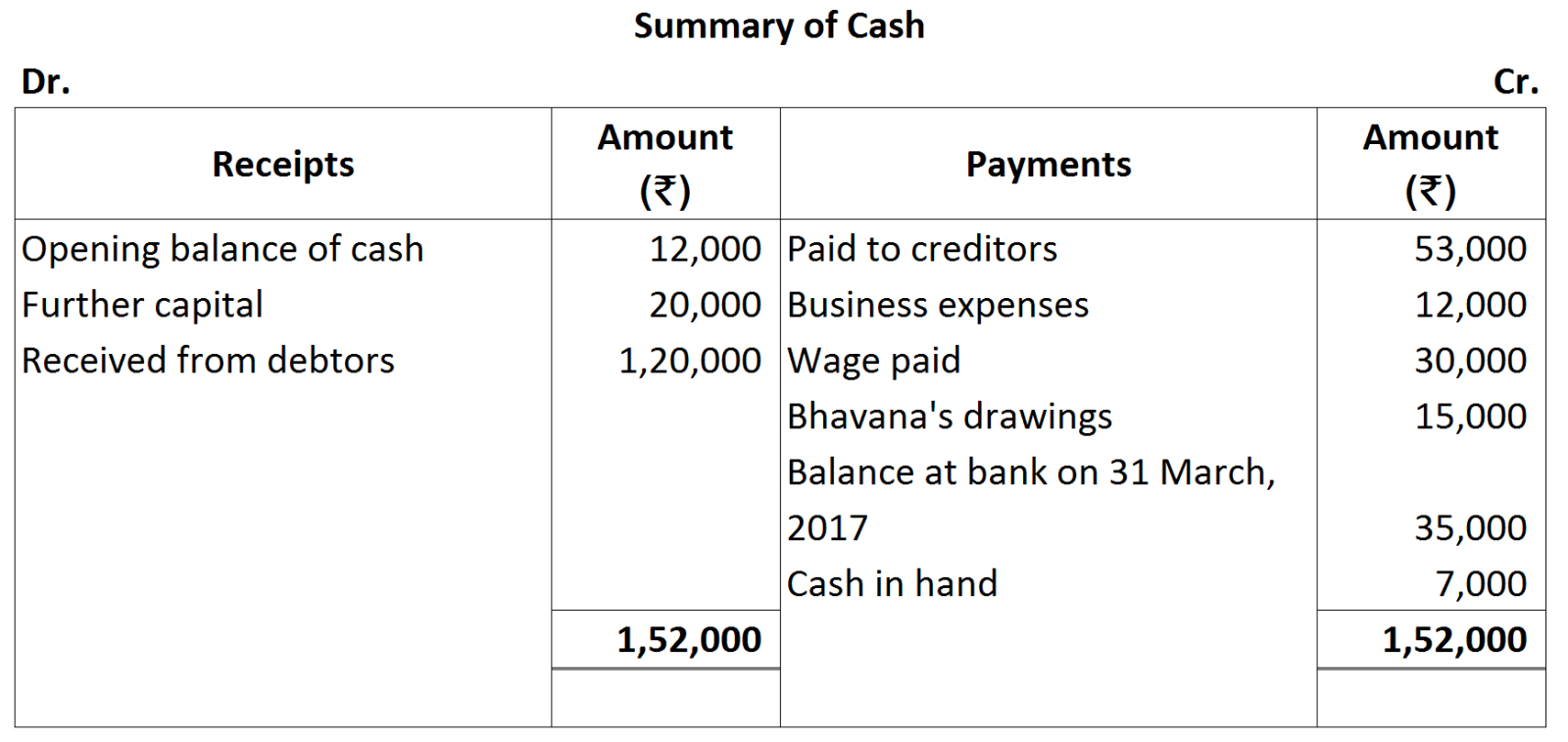
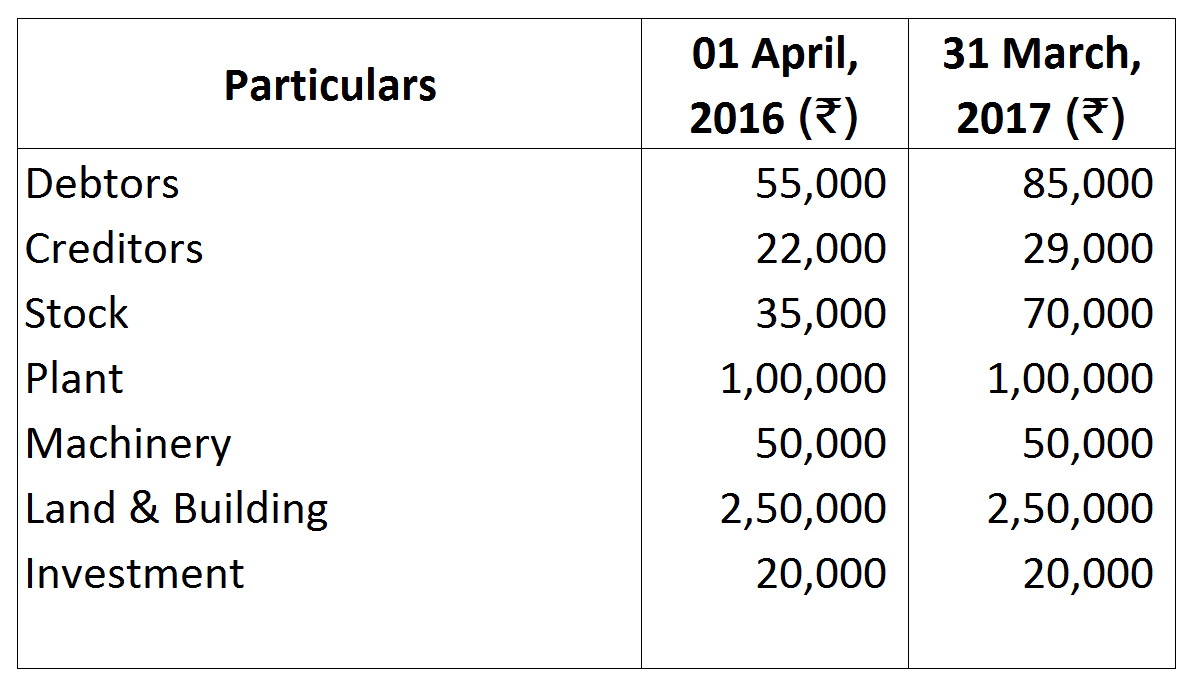
Mrs. Bhavana keeps his books by Single Entry System. You’re required to prepare final accounts of her business for the year ended March 31, 2017. Her records relating to cash receipts and cash payments for the above period showed the following particulars:

The following information is also available:

All her sales and purchases were on credit. Provide depreciation on plant and building by 10% and machinery by 5%, make a provision for bad debts by 5%.
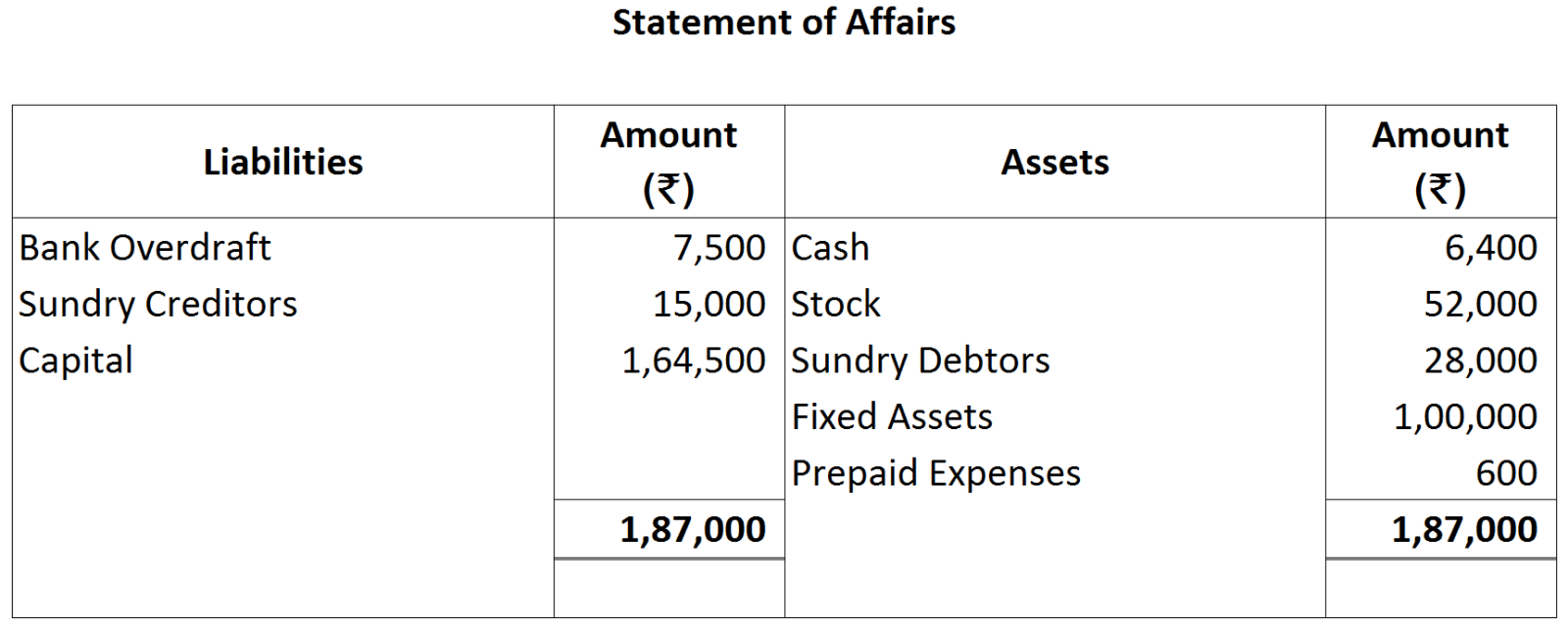
Gopal keeps incomplete records. On $1^{st}$ April, $2016, $ his position was as follows:
His position on $31^{st}$ March, $2017$ was as follows: Cash in hand $₹\ 3,000;$ Cash at Bank $₹\ 5,000;$ Stock $ ₹\ 44,000;$ Debtors $₹\ 21,000$; Fixed Assets $₹\ 80,000$; Creditors $₹\ 22,000$. You are informed that Gopal has taken stocks worth $₹\ 4,500$ for his private use and that he has been regularly transferring $₹\ 2,000$ per month from his business banking account by way of drawings. Out of his drawings he spent $₹\ 15,000$ for purchasing a Scooter for the business on $1$st October, $2016.$

You are requested to find out his profit or loss and to prepare the Statement of Affairs after considering the following:
  1. Depreciate Fixed Assets and Scooter by $10\%$ p.a.
  2. Write off Bad-Debts $₹\ 1,000$ and provide $5\%$ for doubtful debts on Sundry Debtors.
  3. Commission earned but not received by him was $₹\ 2,500.$
What do you understand by database. How does it differ from DBMS?