Question
What are the factors that affect the frequency of a vibrating string and how do they affect the frequency?

Answer

The frequency (f) of a vibrating string is affected by:
(i) The length of the vibrating string. Frequency is inversely proportional to the length, i.e,$f \alpha \frac{1}{1}$. it
means, if length increases, frequency becomes less and if length decreases, frequency increases.
(ii) It is directly proportional to the square root of the tension, other factors remaining the same, e.g., if tension (or stretching force) is made 4 times, then the
frequency will be $(\sqrt{4}=2)$ doubled.
(iii) The frequency, (f) is inversely proportional to the square root of the mass of unit length of the vibrating
string, i.e., $f \alpha \frac{1}{\sqrt{ m ^{\prime}}}$ if $m ^{\prime}$ is the mass of unit length of
the string. Since $m^{\prime}=\pi r^2 . I$, it shows that $f$ is $\alpha \frac{1}{\sqrt{r^2}}$ or
$\frac{1}{ r }$, where $r$ is the radius of the vibrating strings.

Need a full question paper?

Generate a complete, print-ready paper with questions like this in minutes — across 16+ boards, with answer keys.

Start Generating Free

Similar questions

Will the value of specific heat’capacity and specific latent heat of a substance change if the scale is °F instead of °C?
(i) A piece of ice of mass 40 g is dropped into 200 g of water at $50^{\circ} C$. Calculate the final temperature of water after all the ice has melted. (specific heat capacity of water $=4200 J / kg { }^{\circ} C$, specific latent heat of fusion of ice $\left.=336 \times 10^3 H / kg \right)$
(ii) A piece of iron of mass 2.0 kg has a thermal capacity of $966 J / \circ C$.
(a) How mach heat is needed to warm it by $15^{\circ} C$ ?
(b) What is its specific heat capacity in SI units?
(iii) Explain the following :
(a) Why is water used as coolant in motor car radiators?
(b) Why it takes more time to change water at $100^{\circ} C$ to steam at $100^{\circ} C$ compared to heating same mass of water from $0^{\circ} C$ to $100^{\circ} C$ ?
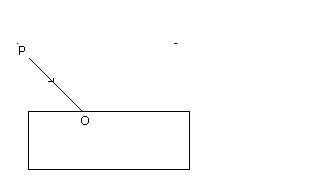
In the fig., PO is a ray of light incident on a rectangular glass block.
(a) Complete the path of the ray through the block.
(b) In the diagram, mark the angle of incidence (i) and the angle of refraction (r) at the first interface. How is the refractive index of glass related to the angles I and r?
(c) Mark angle of emergence by the letter e. How are the angles i and e related?
(d) Which two rays are parallel to each other? Name them.
(e) Indicate in the diagram the lateral displacement between the emergent ray and the incident ray.
An electric kettle has a heating element which is rated at 2 kW when connected to a 250 V electric supply. Calculate the
(a) Current which flows in the element when it is connected to a 250 V supply,
(b) Resistance of the filament,
(c) Heat produced in 1 minute by the element,
(d) Cost of running the kettle for 10 minutes a day for 30 days of the month, at the rate of Rs. 3.00 per unit.
Describe with the aid of a diagram some form of a fuse which is used in the electric lighting circuit of a house. Give two reasons why a fuse must not be replaced by an ordinary copper wire.
$2 kg$ of ice melts when water at $100^{\circ} C$ is poured in a hole drilled in a block of ice. What mass of
water was used? Given: Specific heat capacity of water $=$ $4200 Jkg ^{-1} K ^{-1}$, Lice $=336 \times 10^3 Jkg ^{-1}$.
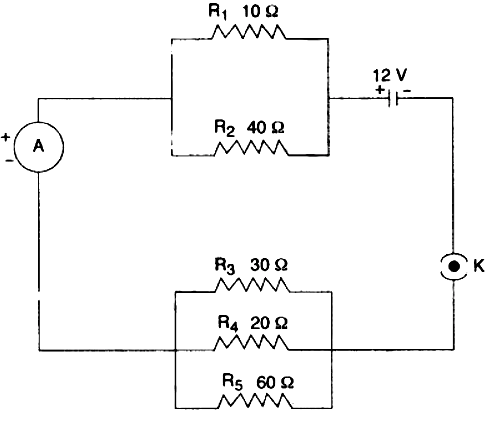
Five resistors of different resistances are connected together as shown in the figure. $A 12$ V battery is connected to the arrangement.

Calculate:
(i) the total resistance in the circuit
(ii) the total current flowing in the circuit.
On a see-saw, two children of masses 30 kg and 50 kg are sitting on one side of it at distance 2 m and 2.5 m respectively, from its middle, where should a man of mass 74 kg sit to balance it?
Three resistances, of which two are equal when connected in series have an effective resistance of $30$ ohms. When the three resistances are connected in parallel, the effective resistances is $3$ ohms. Find the values of the individual resistances.
(i) (a) Define volt.
(b) A wire of uniform thickness with a resistance of $27 \Omega$ is cut into three equal pieces and they are joined in parallel. Find the resistance of the parallel combination.
(ii) (a) What do you understand by the term internal resistance of cell?
(b) Which of the two cables, one of 10 A and other of 20 A will be thicker? Give one reason for your answer.
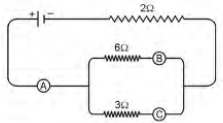
(iii) In the given figure, $A , B$ and C are three ammeters. The ammeter B reads 0.5 A (All the ammeters have negligible resistance.)
ImageCalculate:
(a) the readings in the ammeters A and C .
(b) the total resistance of the circuit.