Question
What are the limitations of index numbers?

Answer

Although index numbers are indispensable tools in economics, business, management etc, they have their limitations and proper care should be taken while interpreting them. Some of the limitations of index numbers are as given below:
  1. Not based on all items: Since index numbers are generally based on a sample, it is not possible to take into account each and every item in the construction of index.
  2. Not free from Error: At each stage of the construction of index numbers, starting from selection of commodities to the choice of formulae there is a chance of the error being introduced. Index numbers are also special type of averages, since the various averages like mean, median, GEOMETRIC MEAN have their relative limitations, their use may also introduce some error. None of the formulae for the construction of index numbers is exact and contains the so called formula error. For example Laspayer's index number has an upward bias while Paasche's index has a downward bias.
  3. Meant for Particular Purpose: An index number is used to measure the change for a particular purpose only. Its misuse for other purpose would lead to unreliable conclusions.
  4. Difference of Time: With the passage of time, it is difficult to make comparisons of index numbers. Over time a person's habit, taste etc. Also undergo change. Consequently, index numbers constructed on the basis of old consumption pattern and hence it becomes obsolete over time. In the construction of price or quantity index numbers it may not be possible to retain the uniform quality of commodities during the period of investigation.
  5. Difficulty in getting data on retail prices: Retail prices vary a great deal from place to place. Most of the index numbers are prepared on the basis of whole sale prices.
  6. International Comparison is not Possible: Different countries develop their indices different years as base years and hence inter-country comparison is not possible by using international comparison.

Need a full question paper?

Generate a complete, print-ready paper with questions like this in minutes — across 16+ boards, with answer keys.

Start Generating Free

Similar questions

Read the following information carefully which records production possibilities for two goods X and Y for a hypothetical economy and answer the questions 1-6 on the basis of the same:
CombinationGood-X (Units)Good-Y (Units)
A030
B128
C224
D318
E410
F50
1. On the basis of the data given above, the marginal opportunity cost between points B and C will be _________.
(a) 2
(b) 4
(c) 6
(d) 8

2. On the basis of the data given above, calculate the marginal opportunity cost between points E and F.
(a) 2
(b) 2.5
(c) 5
(d) 10

3. Identify the shape of PPC for the above data.
(a) Downward sloping concave PPC
(b) Downward sloping convex PPC
(c) Downward sloping straight line PPC
(d) None of these

4. Identify the correct formula to calculate Marginal Opportunity Cost.
(a) $\frac{\Delta Y \text { (gain of output) }}{\Delta X \text { (loss of output) }}$
(b) $\frac{\Delta Y \text { (loss of output) }}{\Delta X \text { (gain of output) }}$
(c) $\frac{\Delta X \text { (gain of output) }}{\Delta Y (\text { loss of output })}$
(d) None of these

5. Read the following statements carefully and choose the correct alternative among those given below:
Statement 1: Marginal opportunity cost refers to value of a factor in its next best (or second best) alternative use.
Statement 2: Technological advancement shifts the PPC to the right.
Alternatives:
(a) Both the statements are true
(b) Both the statements are false
(c) Statement 1 is true and Statement 2 is false
(d) Statement 2 is true and Statement 1 is false

6. If marginal rate of transformation is constant, PPC will be _________.
(a) downward sloping concave
(b) downward sloping convex
(c) downward sloping straight line
(d) none of these
Represent the following data of annual profits of a firm through a time series graph:
Years
2013
2014
2015
2016
2017
2018
Profits (in '000 ₹)
60
72
75
65
80
95
Explain the causes for a leftward shift of demand curve.
Find the standard deviation from the following data:
Marks: $0-10$ $10-20$ $20-30$ $30-40$ $40-50$
No. of Students: $10$ $15$ $10$ $10$ $5$
Calculate the mean deviation from median and coefficient of $MD$ from the given data.
X Frequency
12 8
18 12
25 15
35 23
47 16
55 18
62 31
75 12
Find arithmetic mean from the following data using step-deviation method:
Temperature (°C)
-40 to -30
-30 to -20
-20 to -10
-10 to 0
0 to 10
10 to 20
20 to 30
No. of Days
10
28
30
42
65
180
10
Define Median. Discuss its merits and demerits.
Calculate the upper and lower quartiles for the following frequency distribution.
Class Interval
Frequency (f)
13-25
6
25-37
11
37-49
23
49-61
7
61-73
3
Total
50
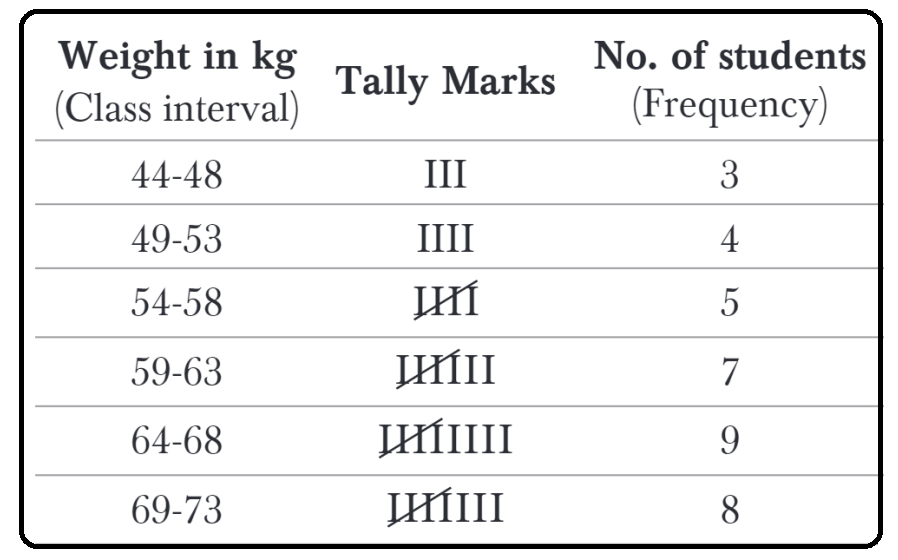
Direction Read the following case study table carefully and answer questions 1 to 5 on the basis of the same.
  1. The above series is an example of ..... series.
  1. Inclusive
  2. Exclusive
  3. Both (a) and (b)
  4. Neither (a) nor (b)
  1. The above situation shows which of the following types of presentation of data?
  1. Chronological classification
  2. Spatial classification
  3. Qualitative classification
  4. Quantitative classification
  1. What is the percentage of students having weight more than 63 kgs?
  1. 43.25%
  2. 47.22%
  3. 51.63%
  4. 62.32%
  1. How many students have weight less then 58 kgs?
  1. 12
  2. 15
  3. 7
  4. 10
  1. Variable which doesn't take integral values is known as .....
  1. Individual series
  2. Discrete series
  3. Continuous series
  4. None of the above
How is the demand for a commodity affected by changes in the price of related goods? Explain with the help of diagrams.