Question
What are the major differences between metals and non-metals?

Answer

(i) Metals have property to loose electron and form cations while non-metals accepts electron and form anion.
(ii) Metals are more electropositive while non-metals are electronegative.
(iii) Metals are strong reductants while non-metals are oxidants.
(iv) Metals are generally solid while non-metals are either solid or gas.
(v) Metallic oxides are basic or amphoteric, while oxides of non-metals are acidic or neutral.
(vi) The melting and boiling points of metals are high while that of non-metals are low.
(vii) Metals are conductor of heat and electricity while non-metals are not.
(viii) Metals are ductile and malleable while non-metals are brittle.

Need a full question paper?

Generate a complete, print-ready paper with questions like this in minutes — across 16+ boards, with answer keys.
Start Generating Free

Similar questions

1M solution of NaNO3 has density 1.25g cm-3.Calculate its molality.
(Mol. weight of NaNO3 = 85g mol-1)
Dinitrogen and dihydrogen react with each other to produce ammonia according to the following chemical equation:
N2(g) + H2(g) → 2NH3(g)
Calculate the mass of ammonia produced if 2.00 × 10³g dinitrogen reacts with 1.00 × 10³g of dihydrogen.
Calculate the entropy change in surroundings when 1.00 mol of H2O(l) is formed under standard conditions. $ \Delta_{\text{f}}\text{H}^\ominus=-286\text{kJ} \ \text{mol}^{-1}.$
Find:

  1. The total number and.
  2. The total mass of neutrons in 7 mg of 14C.

(Assume that mass of a neutron = 1.675 × 10⁻²⁷kg).

  1. Write the resonance structures for CO2.
  2. Draw Lewis structure of H2SO4.
  3. Why KHF2 exist but KHCI2 does not?
How much sugar (C12H22O11) will be required if each person on the earth is given 1015 moles of sugar per day. Population of the earth is 3 × 10¹⁰.
Write the electronic configurations of the following ions:
  1. H
  2. Na+
  3. O2–
  4. F
1. The fact that the enthalpy is a state function forms the basis of a very useful law. Name the law.
2. Two liters of an ideal gas at a pressure of 10 atm expands isothermally at $25^{\circ} C$ into a vacuum until its total volume is 10 liters. How much heat is absorbed and how much work is done in the expansion?
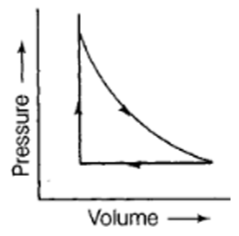
3. A sample of 1.0 mole of a monoatomic ideal gas is taken through a cyclic process of expansion and compression as shown in the figure. What will be the value of $\Delta H$ for the cycle as a whole?
Image
How will you calculate work done on an ideal gas in a compression, when the change in pressure is carried out in infinite steps?