Question
What are the major groups of microorganisms ?

Answer

Microorganisms are divided into four major groups which are as follows
(i) Bacteria These are single-celled organisms having rigid cell was like plant cells. Diseases like typhoid and tuberculosis (TB) are caused by bacteria.
(ii) Fungi These are non-green organisms which obtain their food from the dead organic matter.
(iii) Protozoa These are unicellular animals which cause diseases like malaria and dysentery.
(iv) Algae These are photoautotrophic organisms, that may be unicellular or multicellular.

Need a full question paper?

Generate a complete, print-ready paper with questions like this in minutes — across 16+ boards, with answer keys.
Start Generating Free

Similar questions

Define frictional force (or friction).
You are a member of the municipal body of your town. Make a list of measures that would help your town to ensure the supply of clean water to all its residents.
Give examples to show that friction depends on the nature of two surfaces in contact.
Fill up the blanks with the terms given below: Amoeba is a ___________ celled organism. It reproduces by ___________ reproduction. The process of reproduction begins by the division of its ___________ into two. This is followed by the division of its ___________ into two. This type of reproduction is called ___________ fission.
The synthetic fibre $A$ is chemically a polyamide whereas the synthetic fibre $B$ contains a large number of ester groups. Another synthetic fibre $C$ is made of a polymer $D$ which consists of a number of glucose units joined one after the other.
$a.$ Which fibre could be $(i)$ terylene $(ii)$ rayon, and $(iii)$ nylon?
$b.$ Name the polymer $D.$
$c.$ Which fibre ($A, B$ or $C$) is prepared from a natural raw material?
$d.$ Which fibre ($A, B$ or $C$) contains the same type of groups as those in a $PET$ jar?
Classify the following elements into metals, non-metals and metalloids:
Copper, Sulphur, Aluminium, Oxygen, Silicon, Nitrogen, Germanium, Mercury, Chlorine, Sodium.
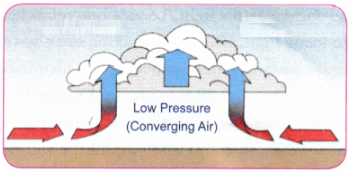
Discuss the role of pressure and particle movement in explaining weather phenomena like winds and cyclones. How does understanding particle behaviour in the air help us predict such events?
Image
What makes the middle zone of a candle flame luminous (or light-giving)?
What are non-metals? Name five non-metals.
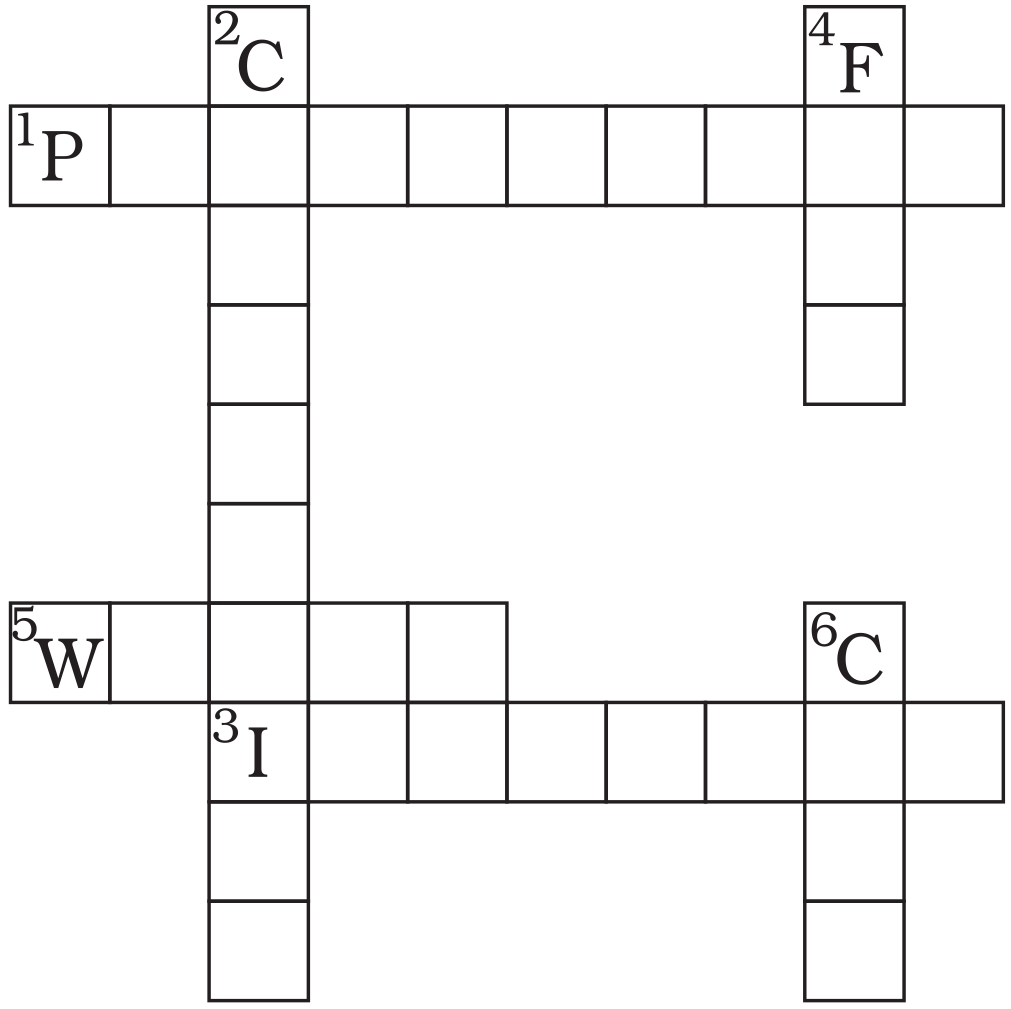
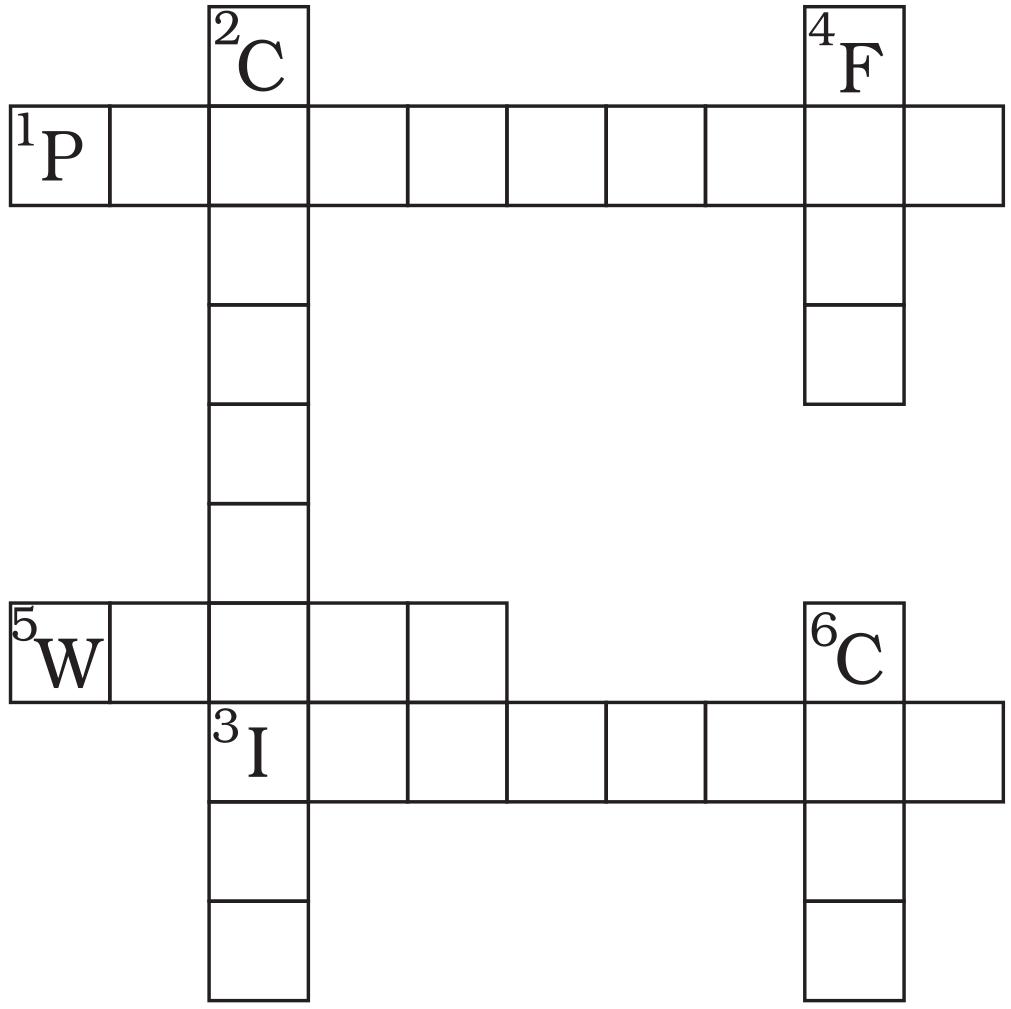
Complete the crossword Fig. with the help of the clues:

Across
$1.$ Non$-$metal which catches fire if exposed to air. $(10)$
$3.$ The lowest temperature at which a substance catches fire is called its $………$ temperature. $(8)$
$5.$ The most common fire extinguisher. $(5)$
Down
$2.$ A chemical process in which a substance reacts with oxygen to give off heat. $(10)$
$4.$ Petrol is used as a $……..$ in automobiles. $(4)$
$6.$ It is as hard as stone and black in colour. $(4)$