Question
What are the types of ecosystems? Give their suitable examples.

Answer

Ecosystems are of two types, viz. natural ecosystem and artificial ecosystem.
(1) Natural ecosystems : The ecosystems which operate under natural conditions without any much major interference by man are called natural ecosystems. E.g. terrestrial ecosystems such as grasslands, forests, deserts, etc. or aquatic ecosystems such as lakes, river, wetland, etc.

(2) Artificial ecosystems : The man engineered ecosystems which are maintained artificially by man by the addition of energy are called artificial ecosystems. These ecosystems are dependent upon manipulations from human beings. E.g. croplands, aquarium, aquaculture, etc. are the types of artificial ecosystems.

Need a full question paper?

Generate a complete, print-ready paper with questions like this in minutes — across 16+ boards, with answer keys.
Start Generating Free

Similar questions

On a visit to a Hill station, one of your friend suddenly became unwell and felt uneasy.
  1. List two symptoms you would look for to term it to be due to allergy.
  2. Explain the response of the body to an allergen.
  3. Name two drugs that can be recommended for immediate relief.
Give Reasons : Possibility of female becoming a haemophilic is extremely rare.
Construct an ideal pyramid of energy when 1,000,000 joules of sunlight is available. Label all its trophic levels.
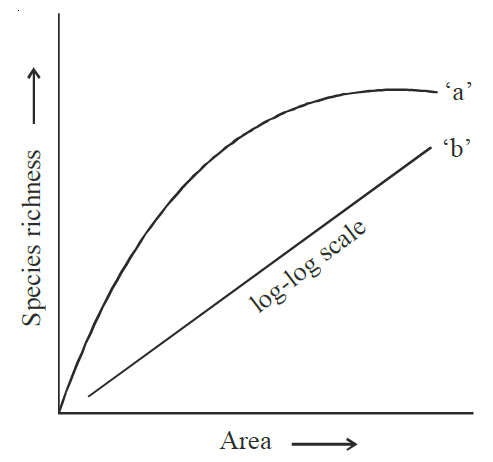
The following graph shows the species-area relationship. Answer the following question as directed.
  1. Name the naturalist who studied the kind of relationship shown in the graph. Write the observation made by him.
  2. Write the situations as discovered by the ecologists when the value of 'Z' (slope of the line) lies.
  1. 0.1 and 0.2
  2. 0.6 and 1.2
What does 'Z' stand for?
  1. When would the slope of the line 'b' become steeper?
  1. Why is there a fear amongst the guardians that their adolescent wards may get trapped in drug/ alcohol abuse?
  2. Explain 'addiction' and 'dependence'in respect of drug/ alcohol abuse in youth.
Describe steady population with the help of a pyramid.
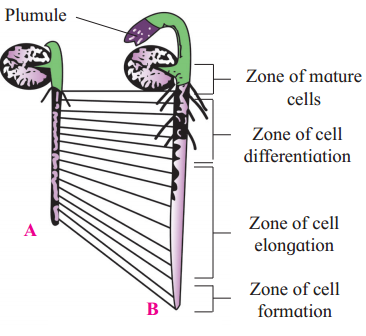
Observe the diagram and answer the questions related to it.

Image

  1. From which cells newly formed cells are added? How?
  2. How is rate of growth in zone of cell elongation?
  3. What is peculiarity of zone of differentiation? How is rate of growth in this region?
Draw the sigmoid growth curve.
1.How and at what stage does Plasmodium enter into a human body?2.With the help of a flow-chart only show the stages of asexual reproduction in the life-cycle of the parasite in the infected an.
3.Why does the victim show symptoms of high fever?
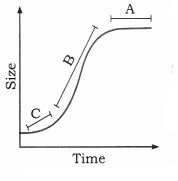
Observe the adjacent graph indicating growth. What is correct labelling of A, B and C respectively?

Image