Question
What are the Vedas? What is their message?

Answer

The Vedas are a collection of ancient sacred texts that form the foundation of Hinduism. They are written in Sanskrit and are considered the oldest and most authoritative scriptures in Hindu religious tradition. The term "Veda" means "knowledge" or "wisdom." There are four Vedas:
1. Rigveda : The oldest of the Vedas, it consists of hymns dedicated to various deities.
2. Samaveda : It consists mainly of verses that are meant to be sung rather than recited.
3. Yajurveda : Contains prose mantras used in ritual offerings.
4. Atharvaveda : It includes a diverse range of topics, including remedies for physical and mental ailments.
Teachings of Vedas: Vedas provide a guideline on living a righteous life, including virtues like truthfulness, charity, and respect for all living beings. They emphasize the unity of the individual soul (Atma) with the universal soul (Brahma). They uphold one's duty and living in harmony with the cosmic order. They advocate for a balanced life that includes fulfilling material needs while also striving for spiritual growth. They provide a comprehensive framework for understanding the universe, human existence, and the relationship between the divine and the mortal.
Need a full question paper?

Generate a complete, print-ready paper with questions like this in minutes — across 16+ boards, with answer keys.

Start Generating Free

Similar questions

Write a note on Oceans.
The diet of Harappans was quite diverse. Validate the statemtent.
What is the primary sector? How is it different from the secondary sector? Give two examples.
Find following places in map.
(a) Sarnath
(b) Mathura
(c) Mahabalipuram
(d) Aihole
What is the difference between a Gram Sabha and a Gram Panchayat?
For each characteristic in the list above, can you make a list of professions or occupations that might exist in such a society?
Question Box :
How does the Municipal Corporation get its money ?
Read the source given below and answer the questions that follows.
But when do we come across a name for the entire Indian sub-continent? Because ancient Indian texts are difficult to date, this is not an easy question to answer. The Mahabharata uses the terms
‘Bharatavarsha’ and ‘Jambudvipa’, and scholars generally agree that this long poem was written from a few centuries BCE onward.
The first term, ‘Bharatavarsha’, clearly extends to the entire Subcontinent, and the text includes the names of numerous rivers and peoples. ‘Bharatavarsha’ means ‘the country of the Bharatas’. ‘Bharata’ is a name that first appears in the Rigveda, where it refers to one of the main Vedic groups of people. In later literature, several kings named ‘Bharata’ are mentioned.

(i) What are the challenges faced by the scholars in determining when the Indian sub-continent was first referred to by a single name ?
(ii) How does the term ‘Bharatavarsha’ contribute to our understanding of ancient Indian geography and identity ?
(iii) What significance does the name ‘Bharata’ hold in ancient Indian literature and how does its evolution reflect the development of Indian identity ?
Do you grow the cereals you have listed in answer no.7? If yes, draw a chart to show’ the stages in growing them. If not, draw a chart to show how these cereals reach you from the farmers who grow them.
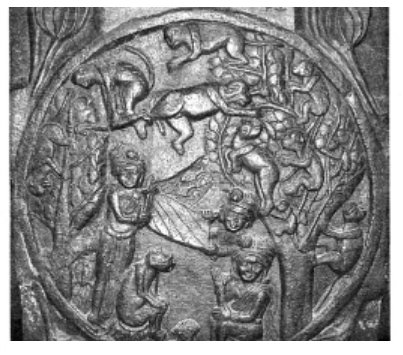
Look at this stone panel found at Bharhut in Madhya Pradesh that depicts the story of the monkey-king. Read the story of the monkey king in the book and answer the following questions.
Image

(a) This story has been taken from the _________.
(b) In this story Buddha has been shown as the _________.
(c) The monkey king had instructed that no fruit from that tree should escape. Why was this instruction given by the king ?
(d) How did the monkey-king save his other monkeys from the soldiers of the king ?