Question
What causes depression in freezing point ?
###
Explain, freezing point depression as a consequence of vapour pressure lowering.
Answer

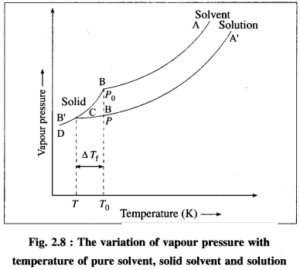
The freezing point of a liquid is the temperature at which the liquid and the solid have the same vapour pressure.

Addition of a nonvolatile solute to a liquid decreases the freezing point, i.e., the freezing point of the solution is less than that of the pure solvent. This is due to the lowering of the vapour pressure of the solvent by the addition of the nonvolatile solute.

When a liquid is cooled from the point A, its vapour pressure decreases and at the point B, it freezes (solidifies).

Image

In case of a solution, since the vapour pressure is lowered, the freezing point decreases. Hence, if the solution is cooled from the point A’, it freezes at lower temperature B’, than the pure liquid. This is also due to separation of solvent molecules due to solute molecules decreasing their intermolecular attraction.

If $T_0$ and $T$ are the freezing points of a pure solvent and the solution, then, the depression in the freezing point is given by,
$\Delta T_f=T_0-T$
This depression $\Delta T_f$ depends on the lowering of the vapour pressure $\left(P_0-P\right) . \Delta T_f \propto\left(P_0-P\right)$, where $P_0$ and $P$ are the vapour pressures of the pure liquid and the solution.

Need a full question paper?

Generate a complete, print-ready paper with questions like this in minutes — across 16+ boards, with answer keys.

Start Generating Free

Similar questions

Give the similarities and differences in elements of 3d, 4d and 5d series.
Predict the sign of $\Delta S$ in the following processes. Give reasons for your answer: ### Explain with reason sign conventions of $\Delta S$ in the following reactions.
(a) $N _2 O _{4( g )} \longrightarrow 2 NO _{2( g )}$
(b) $Fe _2 O _{3( s )}+3 H _{2( g )} \longrightarrow 2 Fe _{( s )}+3 H _2 O _{( g )}$
(c) $N _{2( g )}+3 H _{2( g )} \longrightarrow 2 NH _{3( g )}$
(d) $MgCO _{3( s )} \longrightarrow MgO _{( s )}+ CO _{2( g )}$
(e) $CO _{2( g )} \longrightarrow CO _{2( s )}$
(f) $C l _{2( g )} \longrightarrow 2 Cl _{( g )} \quad$
How are $XeO_3$ and $XeOF_4$ prepared?
Give the structures of the following compounds :
(1) Is galactose an aldohexose or a ketohexose?
(2) Which carbon in galactose has different configuration compared to glucose?
(3) Draw Haworth formulae of α-D-galactose and β-D-galactose.
(4) Which disaccharides among sucrose, maltose and lactose is/are expected to give positive Fehling test?
(5) What are the expected products of hydrolysis of lactose?
From the rate expressions for the following reactions, determine their order :
(a) $2 N _2 O _{5( g )} \rightarrow 4 NO _{2( g )}+ O _{2( g )}:$ Rate $= k \left[ N _2 O _5\right]$
(b) $CHCl _{3( g )}+ Cl _{2( g )} \rightarrow CCl _{4( g )}+ HCl _{( g )}:$ Rate $= k \left[ CHL _3\right]\left[ Cl _2\right]^{1 / 2}$
(c) $C _2 H _5 Cl _{( g )} \rightarrow C _2 H _{4( g )}+ HCl _{( g )}$ : Rate $= k \left[ C _2 H _5 Cl \right]$
(d) $2 NO _{2( g )}+ F _{2( g )} \rightarrow 2 NO _2 F _{( g )} \rightarrow$ : Rate $= k \left( NO _2\right]\left[ F _2\right]$
Write the IUPAC names of the following amines :
Explain the trend in following atomic properties of group 16 elements.
i. Atomic radii
ii. Ionisation enthalpy
iii. Electronegativity.
Calculate the mass of $Mg $ and the volume of Chlorine gas at $\text{NTP}$ produced during the electrolysis of molten $\ce{MgCl} _2$ by the passage of $2$ amperes of current for $1$ hour. Molar masses of $Mg$ and $Cl 2$ are $24 g \ mol -$1 and $71 g \ mol -1$ respectively.
What are ligands? What are their types? Give one example of each type.