Question
What challenges did Mendeleev face in following periodic law?

Answer

The challenges faced by Mendeleev while following periodic law were:
  1. Mendeleev had to arrange the elements with the thought that the information available till then was not final but it could change.
  2. He had to revise the atomic masses of some elements so as to give them a proper place in the periodic table in accordance with their properties. For example, the previously determined atomic mass of beryllium, 14.09, was changed to the correct value 9.4, and beryllium was placed before boron.
  3. He had to keep some vacant places in the periodic table for elements not discovered till then. However, he predicted the atomic masses and properties of some these unknown elements.
  4. There was no place reserved for noble gases in Mendeleev’s original periodic table. So, when noble gases were discovered, he had to include them. He did this without disturbing the original periodic table by creating ‘zero’ group.
  5. He had to indicate a question mark before the symbol of the element due to uncertainty in the names of some of the elements.
  6. There was ambiguity regarding the sequence of elements having a whole number atomic mass such as Co and Ni.
  7. It was difficult to place isotopes of elements as they have the same chemical properties but different atomic masses.
  8. It was not possible to predict how many elements could be discovered between two heavy elements as the rise in atomic mass is not uniform. In addition to this, it was difficult to decide the position of hydrogen in the periodic table.

Need a full question paper?

Generate a complete, print-ready paper with questions like this in minutes — across 16+ boards, with answer keys.
Start Generating Free

Similar questions

When a person eats sugary food, then organisms A present in his mouth act on sugar to produce a substance B. The substance B first dissolves the calcium salts from the top part C of the tooth and then from its middle part D forming holes E. These holes ultimately reach the part F in the lower part of tooth which contains nerves and blood vessels. The substance B irritates the nerve endings inside the tooth causing toothache.
  1. What are (i) organisms A, and (ii) substance B?
  2. What are (i) part C, and (ii) part D, of tooth known as?
  3. By what name are the holes E in the tooth known?
  4. Name the part F of the tooth.
  5. What will happen if organisms A reach part F of the tooth known?
No chemical reaction takes place when granules of a rusty-brown solid A are mixed with the powder of another solid B. However, when the mixture is heated, a reaction takes place between its components. One of the products C is a metal and settles down in the molten state while the other product D floats over it. It was observed that the reaction is highly exothermic.
  1. What could the solids A and B be?
  2. What are the products C and D most likely to be?
  3. Write the chemical equation for the reaction between A and B leading to the formation of C.and D. Mention the physical sates of all the reactants and products in this equation and indicate the heat change which takes place.
  4. What is the special name of such a reaction? State one use of such a reaction.
  5. Name any two types of chemical reactions under which the above reaction can beclassified.
State whether an electric heater will consume more electrical energy or less electrical energy per second when the length of its heating element is reduced. Give reasons for your answer.
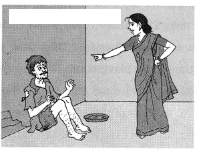
Whether the incidence shown in the following picture is rational? Express your opinion.
Image
Which type/types of power generation involve maximum number of steps of energy conversion? In which power generation is the number minimum?
Write in brief about progressive changes in animal classification.
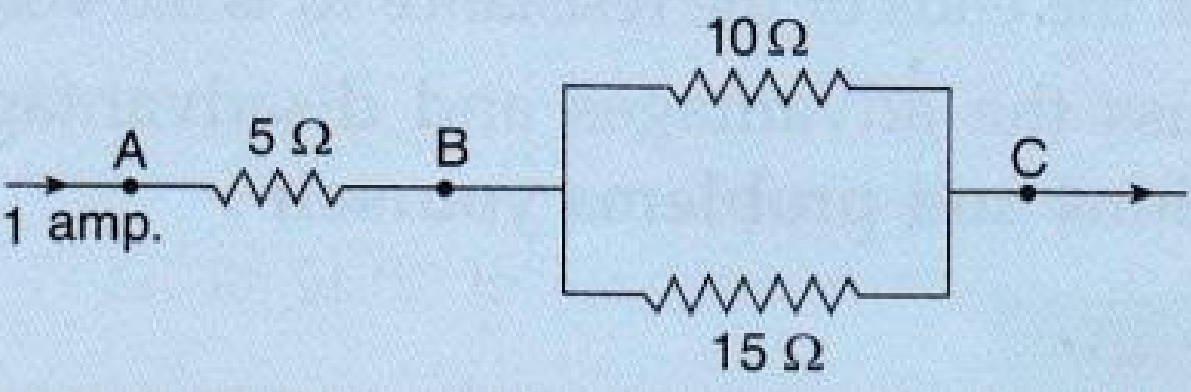
Three resistors are connected as shown in the diagram.

Through the resistor $5$ ohm, a current of $1$ ampere is flowing,
  1. What is the current through the other two resistors?
  2. What is the p.d. across $AB$ and across $AC?$
  3. What is the total resistance?
Explain the mechanism of photosynthesis.
How can you relate the formation of water droplets on the outer surface of a bottle taken out of a refrigerator with formation of dew?
“Only variations that confer an advantage to an individual organism will survive in a population”. Do you agree with this statement? Give reason for your answer.