Question
What characteristics do you expect from an electron-deficient hydride with respect to its structure and chemical reactions?

Answer

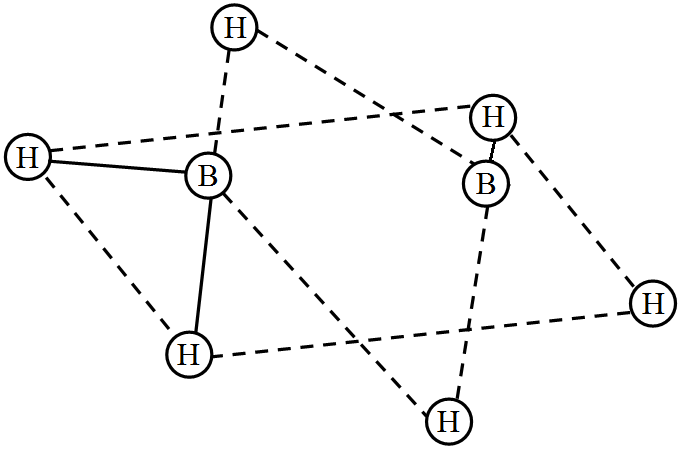
An electron-deficient hydride does not have sufficient electrons to form a regular bond in which two electrons are shared by two atoms e.g., $\mathrm{B}_2 \mathrm{H}_6, \mathrm{Al}_2 \mathrm{H}_6$ etc.
These hydrides cannot be represented by conventional Lewis structures. $\mathrm{B}_2 \mathrm{H}_6$, for example, contains four regular bonds and two three centered-two electron bond. Its structure can be represented as,

Since these hydrides are electron-deficient, they have a tendency to accept electrons. Hence, they act as Lewis acids.
$\text{B}_2\text{H}_6+2\text{NM}_3\xrightarrow{\ \ \ \ \ \ \ \ \ }2\text{B}\text{H}_3\cdot\text{NMe}_3$

Need a full question paper?

Generate a complete, print-ready paper with questions like this in minutes — across 16+ boards, with answer keys.
Start Generating Free

Similar questions

Write the expression for the equilibrium constant, $K _{ C }$ for each of the following reactions:
a. $2 NOCl ( g ) \rightleftharpoons 2 NO ( g )+ Cl _2(g)$
b. $2 Cu \left( NO _3\right)_2(s) \rightleftharpoons 2 CuO ( s )+4 NO _2(g)+ O _2(g)$
c. $CH _3 COOC _2 H _5( aq )+ H _2 O ( l ) \rightleftharpoons CH _3 COOH ( aq )+ C _2 H _5 OH ( aq )$
d. $Fe ^{3+}( aq )+3 OH ^{-}( aq ) \rightleftharpoons Fe ( OH )_3(s)$
e. $I _2(s)+5 F_2 \rightleftharpoons 2 IF _5$
Why was a change in the Bohr Model of atom required? Due to which important development (s), concept of movement of an electron in an orbit was replaced by, the concept of probability of finding electron in an orbital? What is the name given to the changed model of atom?
What will be the pressure of the gaseous mixture when 0.5 L of $\mathrm{H}_2$ at 0.8 bar and 2.0 L of dioxygen at 0.7 bar are introduced in a 1 L vessel at $27^{\circ} \mathrm{C}$ ?
Calculate the molarity of a solution of ethanol in water, in which the mole fraction of ethanol is 0.040 (assume the density of water to be one).
Why is benzene extra ordinarily stable though it contains three double bonds?
When heated in air, the alkali metals form various oxides. Mention the oxides formed by $Li, Na$ and $K$.
  1. Arrange the following according to given property
$\text{CH}_3\stackrel{\oplus \ \ \ }{\text{CH}}_2,\text{C}_6\text{H}_5-\stackrel{\oplus\ \ \ \ }{\text{CH}}_2,(\text{CH}_3)_3\stackrel{\oplus \ \ \ \ }{\text{CH}},$
$\text{CH}_2=\text{CH}-\stackrel{\oplus\ \ \ \ }{\text{CH}}_2$ (decreasing order of stability)
  1. $\text{HC}\equiv\text{C}^{\ominus},\text{Ch}_2=\stackrel{\ominus\ \ \ \ \ \ }{\text{CH}_2},\text{CH}_3-\stackrel{\ominus\ \ \ \ \ }{\text{CH}_2},\stackrel{\ominus \ \ \ \ \ }{\text{CH}_3}$ (increasing order of stabillity)
  2. $\text{C}_6\text{H}_5\stackrel{\bf. \ \ \ \ }{\text{CHCH}_3},\text{C}_6\text{H}_5\text{CH}_2\stackrel{\bf.\ \ \ \ \ }{\text{CH}_2},\text{C}_6\text{H}_5\stackrel{\bf.}{\text{C}}_3(\text{CH}_3)_2$ (increasing order of stabillity)
  3. $\text{CH}_3-\stackrel{\oplus \ \ \ \ }{\text{CH}}-\text{O}-\text{CH}_3,\text{CH}_3-\stackrel{\oplus \ \ \ \ }{\text{CH}},-\text{OCH}_3,$
${\ \ \ \ \ \ \ \ \ \ \ \ \ \ \ \ \ \ \ \ \text{O}}\\{\ \ \ \ \ \ \ \\ \ \ \ \ \ \ \ \ \ \ \ \ \ \\ \|}\\\ \text{CH}_3-\stackrel{\oplus \ \ \ \ }{\text{CH}}\text{C}-\text{OCH}_3$ (decreasing order of stability)
  1.  
In what manner is the long form of periodic table better than Mendeleev’s periodic table? Explain with examples.
Calculate the enthalpy change on freezing of 1.0 mol of water at $10.0^{\circ} C$ to ice at $-10.0^{\circ} C$.
$\Delta_{\text {fus }} H=6.03 kJ mol^{-1} \text { at } 0^{\circ} C .$
$C_{p}\left[H_2 O(l)\right]=75.3 J mol^{-1} K^{-1}$
$C_{p}\left[H_2 O(s)\right]=36.8 J mol^{-1} K^{-1}$
Calculate the wavenumber for the longest wavelength transition in the Balmer series of atomic hydrogen.