Question
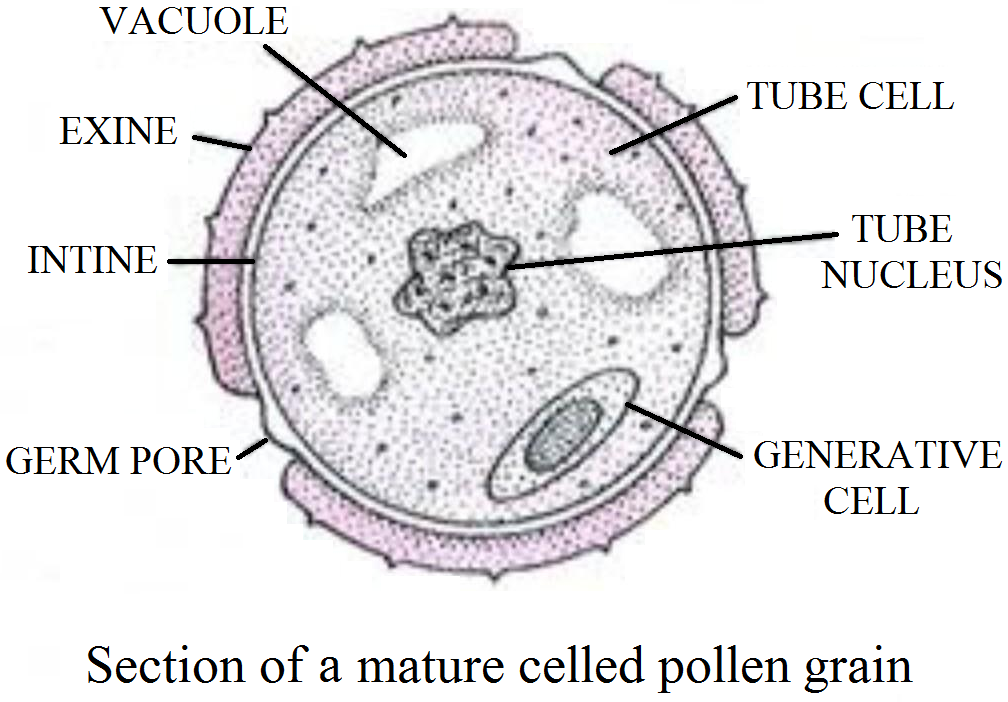
What develops into a microspore mother cell in a flower? Trace the development of this cell into a pollen grain which is ready for germination. Draw a labelled figure of a mature pollen grain.

Answer

Sporogenous cell divide and ultimately transformed into microspore mother cells. Microspore mother cells develop an internal layer of callose which breaks the plasmodesmal connections among themselves. The separated mother cells round off and undergo meiosis to produce tetrads of haploid microspores or pollen grains.

For the structure and development of pollen grain:

Pollen grains or microspores are generally spherical in outline. The wall of pollen grain is called sporoderm, which is made up of two layers-An outer thick exine and an inner thin intine. 

The exine is made up of sporopollenin which is biologically the most resistant substance and can withstand high temperature and strong acids and alkali. At one or more places, the exine is very thin or absent. These regions are called germ pores. 

Intine is continuous layer made up of cellulose and pectin. A mature pollen grain has two cells-a vegetative cell and a generative cell. The vegetative cell is bigger and has food reserve and a large irregular nucleus. The generative cell is small, spindle shaped and floats in the cytoplasm of vegetative cell. In dicots, pollen grains are with three germ pores, while in monocots, they are with single germinal furrow.
Need a full question paper?

Generate a complete, print-ready paper with questions like this in minutes — across 16+ boards, with answer keys.

Start Generating Free

Similar questions

  1. Differentiate between repetitive and satellite DNA.
  2. How can satellite DNA be isolated? Explain.
  3. List two forensic application of this technology.
Draw a neat diagram of the female reproductive system and label the parts associated with the following (a) production of gamete, (b) site of fertilisation (c) site of implantation and, (d) birth canal.
Explain the contribution of Alfred Sturtevant in ‘Chromosome mapping’.
What is Implantation? Describe the process of implantation with diagram.
Define aneuploidy. How is it different from polyploidy? Describe the individuals having following chromosomal abnormalities.
  1. Trisomy of 21st Chromosome.
  2. XXY.
  3. XO.
Write the full name of the word AIDS. By what name is the virus that causes this disease known? Explain the symptoms and prevention measures of AIDS disease. Draw a labelled diagram of the replication of the AIDS virus.
Match the items in Column I with those in Column II
S.No.
Column I
S.No.
Column II
(A)
Standing crop
(i)
The amount of mineral nutrients in the soil at a given time
(B)
Standing state
(ii)
Sedementary cycle
(C)
Climax community
(iii)
Herbivores and carnivores
(D)
Primary producers
(iv)
In near equilibrium with the environment
(E)
Phosporus cycle
(v)
Mass of living matter in a trophic level at a given time
(F)
Secondary producers
(vi)
Phytoplanktons
Explain polygenic inheritance pattern with the help of a suitable example.
Explain the different stages of oogenesis in humans starting from foetal life till its completion. When and where in the body is oogenesis completed?
A flower of tomato plant following the process of sexual reproduction produce 240 viable seeds.
Answer the following questions giving reasons:
What is the minimum number of pollen grains that must have been involved in the pollination of its pistil?