Question
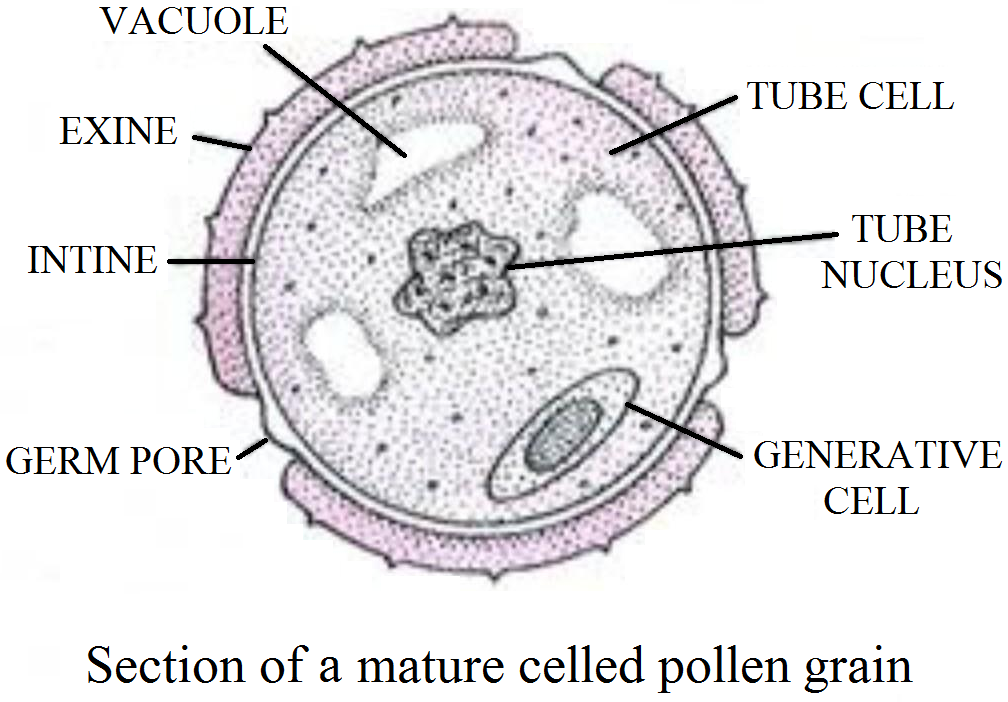
What develops into a microspore mother cell in a flower? Trace the development of this cell into a pollen grain which is ready for germination. Draw a labelled figure of a mature pollen grain.

Answer

Sporogenous cell divide and ultimately transformed into microspore mother cells. Microspore mother cells develop an internal layer of callose which breaks the plasmodesmal connections among themselves. The separated mother cells round off and undergo meiosis to produce tetrads of haploid microspores or pollen grains.

For the structure and development of pollen grain:

Pollen grains or microspores are generally spherical in outline. The wall of pollen grain is called sporoderm, which is made up of two layers-An outer thick exine and an inner thin intine. 

The exine is made up of sporopollenin which is biologically the most resistant substance and can withstand high temperature and strong acids and alkali. At one or more places, the exine is very thin or absent. These regions are called germ pores. 

Intine is continuous layer made up of cellulose and pectin. A mature pollen grain has two cells-a vegetative cell and a generative cell. The vegetative cell is bigger and has food reserve and a large irregular nucleus. The generative cell is small, spindle shaped and floats in the cytoplasm of vegetative cell. In dicots, pollen grains are with three germ pores, while in monocots, they are with single germinal furrow.
Need a full question paper?

Generate a complete, print-ready paper with questions like this in minutes — across 16+ boards, with answer keys.

Start Generating Free

Similar questions

Explain the difference between the following :
(i) Nucleoside and nucleotide
(ii) DNA and RNA
(iii) Codon and anticodon
(iv) Transcription and translation
(v) Inductive regulation and inhibitory regulation
(vi) RNA splicing and RNA editing
  1. Write an equation for Verhaulst-Pearl Logistic Growth, where.

N - Population density at a timet E.

r - Intrinsic rate of natural increase.

K - Carrying Capacity.
  1. Draw a graph for a population whose population density has reached the carrying capacity.
  2. Why is this logistic growth model considered a more realistic one for most animal populations?
  3. Draw a growth curve where resources are not limiting to growth of a population.
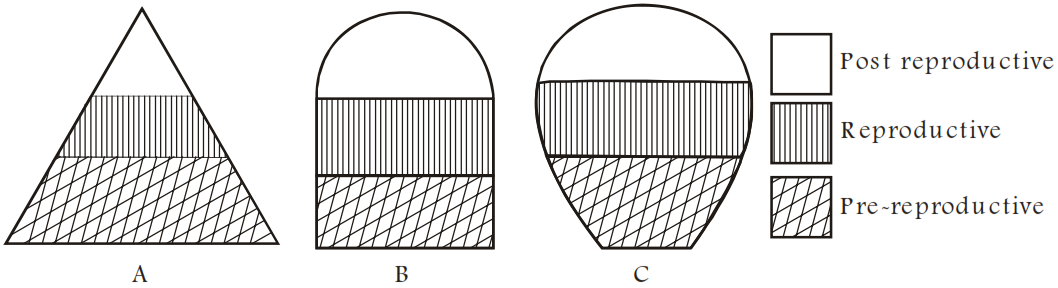
The following diagrams are the age pyramids of different populations. Comment on the status of these populations.

What is innate immunity? How is it accomplished in a human body?
Read the following and answer any four questions from (i) to (v) given below:

Crown gall is a neoplastic disease of most dicotyledonous plants and is caused by the soil bacterium Agrobacterium tumefaciens. A large extra chromosomal plasmid in these bacteria was found to be responsible for this disease. The plasmid is known as Ti plasmid. Bacteria free crown gall cells can be cultured in the absence of phytohormones. Ti plasmid is widely used in genetic engineering to deliver the desirable genes. The part of Ti plasmid transferred into plant cell DNA is called T-DNA. T-DNA with desired DNA segment is inserted into the chromosome of the host plant where it produces copies of itself.

  1. Which of the following is the full full of T-DNA?
  1. Transfer DNA.
  2. Tumour inducing DNA.
  3. Transgenic DNA.
  4. None of these.
  1. Ti plasmid cannot infect and develop crown gall in,
  1. Tomato.
  2. Maize.
  3. Soybean.
  4. sunflower.
  1. While making transgenic plant, T-DNA is inserted into the host cell, it is then:
  1. Integrated into the target host genome.
  2. Lie independent of the host genome.
  3. Rupture the host cell wall.
  4. Produce oncogenic factors in the host.
  1. Agrobacterium mediated gene transfer in plants:
  1. Allows relatively large segment of DNA.
  2. Transfer of DNA with defined ends and minimal rearrangement.
  3. High quality and fertility in transgenic plants.
  4. All of these.
  1. Assertion: In Agrobacterium mediated gene transfer in plants, transgenic plants do not develop tumors.

Reason: In T-DNA tumor producing genes are deleted during the process of gene transfer.

  1. Both assertion and reason are true and reason is the correct explanation of assertion.
  2. Both assertion and reason are true but reason is not the correct explanation of assertion.
  3. Assertion is true but reason is false.
  4. Both assertion and reason are false.
What is rDNA? Explain the technique of cloning rDNA.
Can you list 10 recombinant proteins which are used in medical practice? Find out where they are used as therapeutics (use the internet).
Answer the following questions:
How did Morgan show the deviation in inheritance pattern in Drosophila with respect to this law?
Explain the difference between apes and human.
Define linkage and linkage group. Discuss the effect of linkage and its importance.###What is linkage? Who coined the term? Write the name of the insect used for this study.