Question
What do you know about Harvard Step Test? Explain its procedure and administration.

Answer

Cardiovascular fitness is the ability of the heart and lungs to supply oxygen-rich blood to the working muscle tissues and the ability of the muscles to use oxygen to produce energy for movements. Harvard Step Test is a cardiovascular fitness test. It is also called aerobic fitness test.
Administrative procedure of Harvard Step Test:
Purpose: To measure the general capacity of the heart and circulatory system for measurement of cardiovascular efficiency.
Time Allotment: 5 minutes
Facilities and Equipment: A stop watch, 20″ height bench, partners, stethoscope, metronome, score sheet.
Procedure: The athlete stands in front of the bench or box. On the command ‘Go’ the athlete steps up and down on the bench or box at a rate of 30 steps per minute (one second up one second down) for 5 minutes (150 steps). Stopwatch is also Started simultaneously at the start of the stepping. After that the athlete sits down immediately after completion of the test i.e. after 5 minutes. The total number of heartbeats are counted between 1 to 1.5 minutes after completion of the last step. The heartbeats are counted for 30 se onds period. Again the heartbeats are noted for 30 seconds after the finishing of the test. After that third time the heartbeats are noted after 3 minutes of completion of the test for 30 seconds period. The same foot must start the step up each time, and anerect posture must be assumed on the bench.
Calculation of the Score: The athlete’s fitness index score is calculated with the help of following formula:
Fitness index score $=\frac{(100\times\text{test duration in seconds})}{(2\times\text{sum of heart beats in recovery periods)}}$
“Students own view relevant to this question also acceptable”.

Need a full question paper?

Generate a complete, print-ready paper with questions like this in minutes — across 16+ boards, with answer keys.

Start Generating Free

Similar questions

What do you mean by ‘Healthy-Weight’? Explain the methods to control ‘Healthy- Body Weight to lead healthful-living’.
Explain any five common soft tissue injuries in the game/sport of your choice.
Discuss any three tests of Kraus-Weber tests.
Write in detail about the physiological changes taking place due to ageing.
Explain the meaning and concept of correct posture.
Differentiate between Intrinsic and Extrinsic motivation. Explain in detail Goal Setting and Reinforcement as technique of motivation.
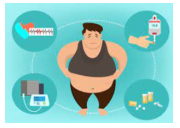
Shruti, a student of class XI is struggling with Obesity due to which she has low self esteem and low confidence. As a result she has started dieting to control her weight. But this dieting program is self designed and lacks knowledge about nutrition
Image
1. As a physical education student, what do you feel will be the pitfalls of this dieting plan?
a) Eating too little, more drinking than eating, skipping meals, intake of labeled
foods, not doing exercises
b) Eating too much, less drinking than eating, regular meals, intake of labeled foods, doing exercises
c) Eating too much, less drinking than eating, regular meals, avoiding labeled foods, doing exercises
d) Eating too little, less drinking than eating, regular meals, avoiding labeled foods, not doing exercises
2. What will be your advice to Shruti to control her weight?
a) Follow a sedentary lifestyle, increase calories, eat junk foods, take an unbalanced diet, avoid physical exercises, and overeat
b) Follow an active lifestyle, cut down calories, avoid junk foods, take a balanced diet, do physical exercises, and avoid overeating
c) Follow a sedentary lifestyle, cut down calories, eat junk foods, take an unbalanced diet, do physical exercises, and overeat
d) Follow an active lifestyle, increase calories, eat junk foods, take a balanced diet, avoid physical exercises, and overeat
3. The meaning of the term Pitfalls of dieting is:
a) Benefits of dieting
b) Drawbacks of dieting
c) Advantages of dieting
d) Disadvantages of exercise
4. A major component of a pre-competition diet is:
a) Proteins
b) Fats
c) Carbohydrates
d) Vitamins