Question
What do you understand by beat? Explain beats analytically.

Answer

For definition, see text:

Consider two simple harmonic progressive waves travelling simultaneously in the same direction and in the same medium. Let

'A' be the amplitude of each wave.

There is no initial phase difference between them.

v1 and v2 be their frequencies.

If y1 and y2 be displacements of the two waves, then

$\text{y}_1=\text{A}\sin2\pi\text{v}_1\text{t}$ and $\text{y}_2=\text{A}\sin2\pi\text{v}_2\text{t}$

If y be the result and displacement at any instant, then

$\text{y}=\text{y}_1+\text{y}_2=\text{A}\sin(2\pi\text{v}_1\text{t})+\sin(2\pi\text{v}_2\text{t})$

$=\text{A}\Bigg[2\sin\Big(\frac{2\pi(\text{v}_1+\text{v}_2)\text{t}}{2}\Big)\cos\Big(\frac{2\pi(\text{v}_1-\text{v}_2)\text{t}}{2}\Big)\Bigg]$

$=2\text{A}\cos\pi(\text{v}_1\text{v}_2)\text{t}\sin \pi(\text{v}_1+\text{v}_2)\text{t}$

$=\text{R}\sin\pi(\text{v}_1+\text{v}_2)\text{t}\ \dots(1)$

where $\text{R}=2\text{A}\cos\pi(\text{v}_1-\text{v}_2)\text{t}\ \dots(2)$

is the amplitude of the resultant displacement and depends upont. The following cases arise.

  1. If R is maximum, then

$\cos\pi(\text{v}_1-\text{v}_2)\text{t}=\text{max}.=\pm1=\cos\text{n}\pi$

$\therefore \pi(\text{v}_1-\text{v}_2)\text{t}=\text{n}\pi$

$\text{t}=\frac{\text{n}}{\text{v}_1-\text{v}_2}\ \dots(3)$

where n = 0, 1, 2...

$\therefore$ Amplitude becomes maximum at times given by

$\text{t}=0,\frac{1}{\text{v}_1-\text{v}_2},\frac{2}{\text{v}_1-\text{v}_2}=\frac{3}{\text{v}_1-\text{v}_2},...$

$\therefore$ Time interval between two consecutive maxima is

$=\frac{1}{\text{v}_1-\text{v}_2}$

$\therefore$ Beat period $=\frac{1}{\text{v}_1-\text{v}_2}$

$\therefore$ Beat frequency $=\text{v}_1-​​\text{v}_2$

$\therefore$ no. of beats formed per sec. $=\text{v}_1-​​\text{v}_2$

  1. If R is minimum, then

$\cos\pi(\text{v}_1-\text{v}_2)\text{t}=\text{min}=0=\cos(2\text{n}+1)\frac{\pi}{2}$

$\therefore \pi(\text{v}_1-\text{v}_2)\text{t}=(2\text{n}+1)\frac{\pi}{2}$

$\text{t}=\frac{(2\text{n}+1)}{2(\text{v}_1-\text{v}_2)},$ where n = 0, 1, 2,...

$\therefore$ Amplitude becomes minimum at times grven by

$\text{t}=\frac{1}{2(\text{v}_1-\text{v}_2)},\frac{3}{2(\text{v}_1-\text{v}_2)},\frac{5}{2(\text{v}_1-\text{v}_2)},...$

$\therefore$ Time interval between two consecutive minima is $=\frac{1}{\text{v}_1-\text{v}_2}.$

$\therefore$ Beat period $=\frac{1}{\text{v}_1-\text{v}_2}.$

$\therefore$ Beat requency = v1 - v2.

$\therefore$ No. of beats formed per sec = v1 - v2.

Hence the number of beats formed per second is equal to the difference between the frequencies of two component waves.

Need a full question paper?

Generate a complete, print-ready paper with questions like this in minutes — across 16+ boards, with answer keys.
Start Generating Free

Similar questions

A train starts from rest and moves with a constant acceleration of 2.0m/s2 for half a minute. The brakes are then applied and the train comes to rest in one minute. Find:
  1. The total distance moved by the train.
  2. The maximum speed attained by the train.
  3. The position(s) of the train at half the maximum speed.
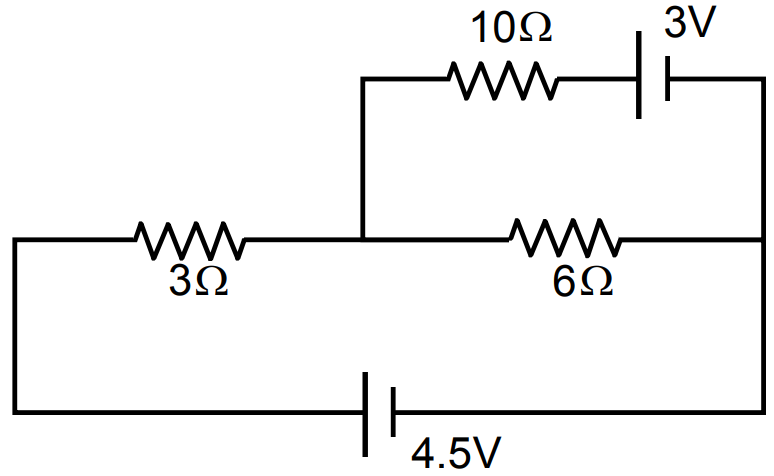
Find the current through the $10\Omega$ resistor shown in figure.

A particle of mass 1g and charge 2.5 × 10-4C is released from rest in an electric field of 1.2 × 104NC-1.
  1. Find the electric force and the force of gravity acting on this particle. Can one of these forces be neglected in comparison with the other for approximate analysis?
  2. How long will it take for the particle to travel a distance of 40cm?
  3. What will be the speed of the particle after travelling this distance?
  4. How much is the work done by the electric force on the particle during this period?
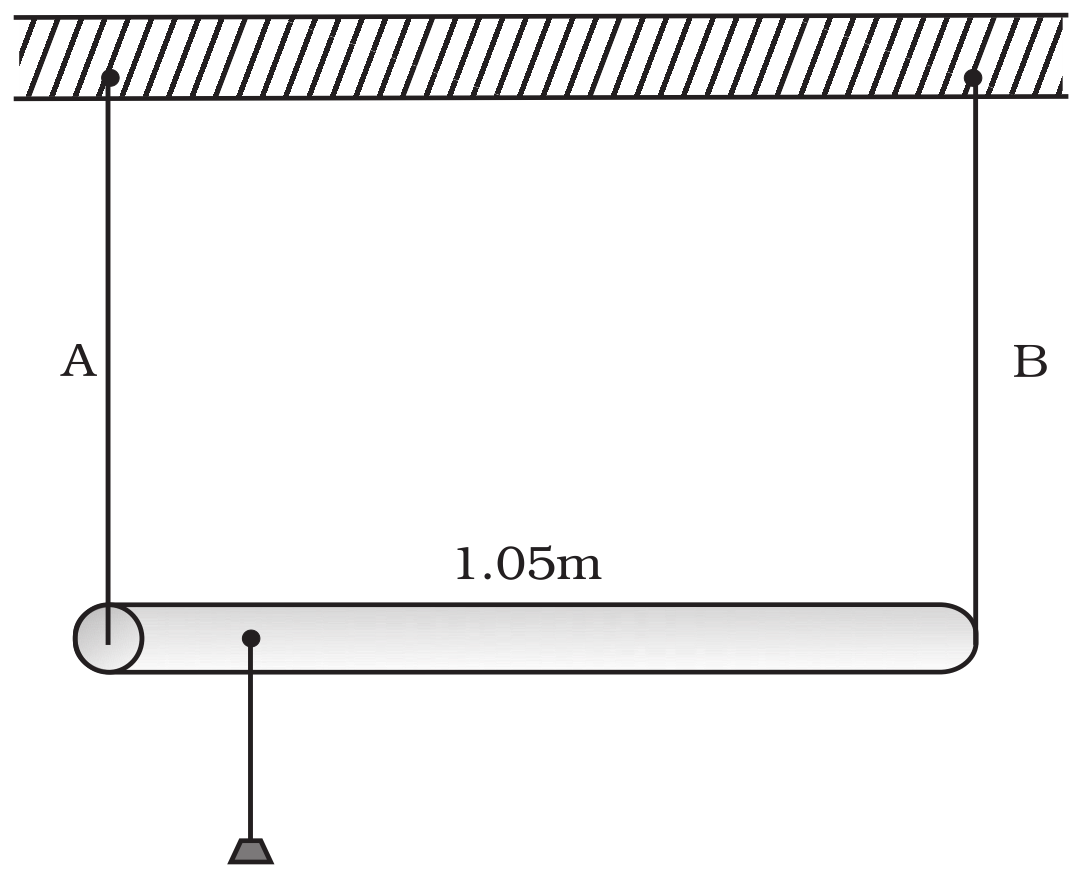
A rod of length 1.05m having negligible mass is supported at its ends by two wires of steel (wire A) and aluminium (wire B) of equal lengths as shown in Fig. The cross-sectional areas of wires A and B are 1.0mm2 and 2.0mm2 , respectively. At what point along the rod should a mass m be suspended in order to produce (a) equal stresses and (b) equal strains in both steel and aluminium wires.

A flask contains argon and chlorine in the ratio of 2 : 1 by mass. The temperature of the mixture is 27°C. Obtain the ratio of (i) average kinetic energy per molecule, and (ii) root mean square speed vrms of the molecules of the two gases. Atomic mass of argon = 39.9u; Molecular mass of chlorine = 70.9u.
(a) When a molecule (or an elastic ball) hits a ( massive) wall, it rebounds with the same speed. When a ball hits a massive bat held firmly, the same thing happens. However, when the bat is moving towards the ball, the ball rebounds with a different speed. Does the ball move faster or slower?
(b) When gas in a cylinder is compressed by pushing in a piston, its temperature rises. Guess at an explanation of this in terms of kinetic theory using (a) above.
(c) What happens when a compressed gas pushes a piston out and expands. What would you observe?
(d) Sachin Tendulkar used a heavy cricket bat while playing. Did it help him in anyway?
One end of a U-tube containing mercury is connected to a suction pump and the other end to atmosphere. A small pressure difference is maintained between the two columns. Show that, when the suction pump is removed, the column of mercury in the U-tube executes simple harmonic motion.
A circular loop carrying a current i is made of a wire of length L. A uniform magnetic field B exists parallel to the plane of the loop.
  1. Find the torque on the loop.
  2. If the same length of the wire is used to form a square loop, what would be the torque? Which is larger?
Hydrogen gas is contained in a closed vessel at 1atm (100kPa) and 300K. (a) Calculate the mean speed of the molecules. (b) Suppose the molecules strike the wall with this speed making an average angle of 45° with it. How many molecules strike each square metre of the wall per second?
A synchronous motor is used to lift an elevator and its load of 1500kg to a height of 20m. The time taken for job is 20s. What is work done? What is the rate at which work is done? If the efficiency of the motor is 75%, at which rate is the energy supplied to the motor?