Question
What do you understand by controlled and uncontrolled chain reactions?

Answer

Controlled chain reaction : If the chain reaction of fission can be controlled in such a way that it neither increases nor decreases, that is, such a level of reaction is maintained such that the energy released per second always remains less than the limit of explosion. This is called controlled chain reaction. This type of reaction is used in the production of electrical energy. Controlled chain reaction is the fundamental basis of 'nuclear reactor'.
Uncontrolled chain reaction : In this reaction, on average, more than one neutron takes part in the process of fission out of the neutrons obtained from each fission. Here $K >1$. Due to this, the rate of fission of nuclei increases rapidly and within a few moments tremendous energy is released and causes a massive explosion. This reaction takes place in the atomic bomb.

Need a full question paper?

Generate a complete, print-ready paper with questions like this in minutes — across 16+ boards, with answer keys.
Start Generating Free

Similar questions

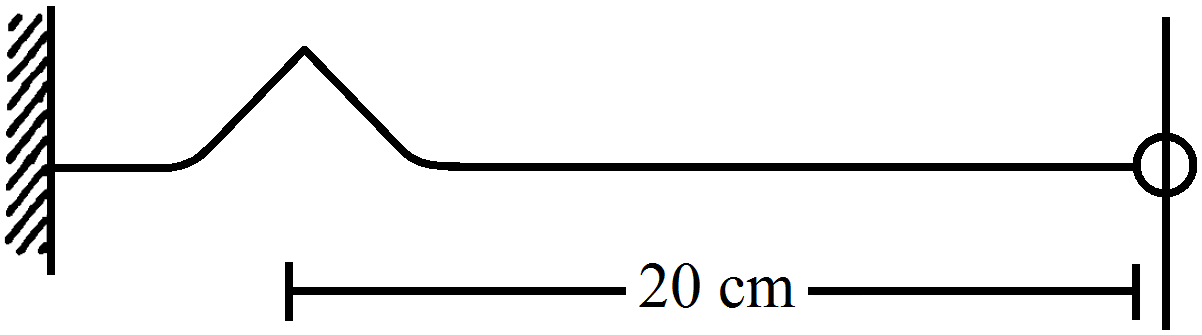
A string of linear mass density 0.5g/cm and a total length 30cm is tied to a fixed wall at one end and to a frictionless ring at the other end figure, The ring can move on a vertical rod. A wave pulse is produced on the string which moves towards the ring at a speed of 20cm/s. The pulse is symmetric about its maximum which is located at a distance of 20cm from the end joined to the ring.
  1. Assuming that the wave is reflected from the ends without loss of energy, find the time taken by the string to regain its shape.
  2. The shape of the string changes periodically with time. Find this time period.
  3. What is the tension in the string?
The radius of gyration of a uniform disc about a line perpendicular to the disc equals its radius. Find the distance of the line from the centre.
Draw a plot of potential energy of a pair of nucleons as a function of their separations. Mark the regions where the nuclear force is (i) attractive and (ii) repulsive. Write any two characteristic features of nuclear forces.
Give explanation about wave front.
###
Explain Wave front.
Draw the graph to show variation of binding energy per nucleon with mass number of different atomic nuclei. Calculate binding energy/nucleon of $^{40}_{20}\text{Ca}$ nucleus. Given: mass of $^{40}_{20}\text{Ca} = 39.962589\text{u}$.
mass of proton $= 1.007825 u.$
mass of neutron $= 1.008665 u. $
and $1 u = 931 MeV/C^{2.}$
A potential difference $V$ is applied across a conductor of length $L$ and diameter $D.$ How is the drift velocity, $V_d,$ of charge carriers in the conductor affected when $(i) \ V$ is halved, $(ii) \ L$ is doubled and $(iii) \ D$ is halved? Justify your answer in each case.
Figure shows a smooth track, a part of which is a circle of radius $R.$ A block of mass m is pushed against a spring of spring constant $k$ fixed at the left end and is then released. Find the initial compression of the spring so that the block presses the track with a force $mg$ when it reaches the point $P,$ where the radius of the track is horizontal.
Define the term self-inductance. Write its SI unit. Give two factors on which self inductance of an air-core coil depends.
A cubical block of mass m and edge a slides down a rough inclined plane of inclination $\theta$ with a uniform speed. Find the torque of the normal force acting on the block about its centre.
Find the temperature at which the average thermal kinetic energy is equal to the energy needed to take a hydrogen atom from its ground state to $n = 3$ state. Hydrogen can now emit red light of wavelength $653.1\ nm.$ Because of Maxwellian distribution of speeds, a hydrogen sample emits red light at temperatures much lower than that obtained from this problem. Assume that hydrogen molecules dissociate into atoms.