Question
What do you understand by forced vibrations?

Answer

Sometimes to keep a body vibrating, a periodic force is applied to it. In such a case, the body does not vibrate with its own natural frequency but gradually starts vibrating with the frequency of the applied periodic force. Such vibrations produced in a body are called forced vibrations, e.g., in a string of musical instruments, when the vibrations producing a loud sound.
Need a full question paper?

Generate a complete, print-ready paper with questions like this in minutes — across 16+ boards, with answer keys.

Start Generating Free

Similar questions

Four cells, each of e.m.f. 1.5 V and internal resistance 2.0 ohms are connected in parallel. The battery of cells is connected to an external resistance of 2.5 ohms. Calculate:
(i) The total resistance of the circuit.
(ii) The current flowing in the external circuit.
(iii) The drop in potential across-the terminals of the cells.
Water in a pond appears to be only three–quarters of its actual depth. What property of light is responsible for this observation? Illustrate your answer with the help of a ray diagram. How is the refractive index of water calculated from its real and apparent depth?
Give two examples each of contact and non-contact forces.
The diagram in Fig. 9.27 shows a three pin plug. Label the three pins.
(a) why if the top pin thicker and longer than the other two?
(b) why are the pins splitted at the ends?
On a see-saw, two children of masses 30 kg and 50 kg are sitting on one side of it at distance 2 m and 2.5 m respectively, from its middle, where should a man of mass 74 kg sit to balance it?
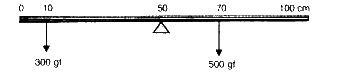
Fig. shows a uniform meter scale weighing 200 gf. Provided at its centre. Two weights 300 gf and 500 gf are suspended from the ruler as shown in the diagram. Calculate the resultant torque of the ruler and hence calculate the distance from mid-point where a 100 gf should be suspended to balance the meter scale.
What do you mean by background radiations? Name its sources. Is it possible for us to keep ourselves away from it?
The following are an example of levers. State the class of lever to which each one belongs giving the relative positions of Load (L), Effort (E), Fulcrum (F):
(i) Scissors (ii) Sugar tongs (iii) Nutcracker (iv) Pliers.
The mechanical advantage of a machine is 5 and its efficiency is $80\%$. It is used to lift a load of 200 kgf to a height of $20 m.$ Calculate:
(i) The effort required, and
(ii) The work done on the machine $(g = 10 ms^{−2}).$
$10 g$ of ice at $0^{\circ} C$ absorbs $5460 J$ of heat energy to melt and change to water at $50^{\circ} C$. Calculate the specific latent heat of fusion of ice. Specific heat capacity of water is $4200 J kg ^{-1} K^{-1}$.