Question
What do you understand by the term derived unit? Give three examples.

Need a full question paper?

Generate a complete, print-ready paper with questions like this in minutes — across 16+ boards, with answer keys.
Start Generating Free

Similar questions

A car travels with uniform velocity of $25 m s ^{-1}$ for 5 s . The brakes are then applied and the car is uniformly retarded and comes to rest in further 10 s . Find:
i. The distance which the car travels before the brakes are applied,
ii. Retardation and
iii. The distance travelled by car after applying the brakes.
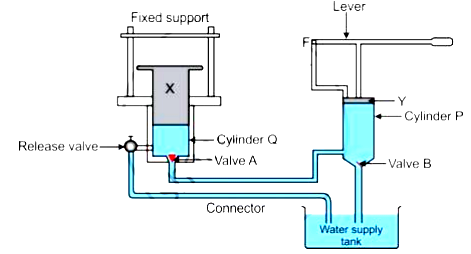
The diagram below in Fig. 4.12 shows a device which makes the use of the principle of transmission of pressure.
  1. Name the parts labelled by the letters X and Y.
  2. Describe what happens to valves A and B and to the quantity of water in the two cylinders when the lever arm is moved down.
  3. Give reasons for what happens to valves A and B in part (ii).
  4. What happens when the release valve is opened?
  5. What happens to valve B in cylinder P when the lever arm is moved up?
  6. Give a reason for your answer in part (v).
  7. State one use of the above device.
What is meant by zero error of vernier callipers ? How is it determined? Draw neat diagrams to explain it. How is it taken in account to get the correct measurement?
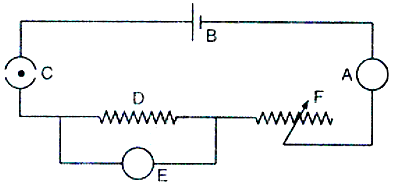
In the electric circuit shown in Figure, label the parts A, B, C, D, E, and F. State the function of each part. Show in the diagram the direction of flow of current.
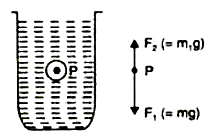
A small stone of mass $m (=200 g)$ is held underwater in a tall jar and allowed to fall as shown in the following figure. The freebody diagram of the stone is also shown.
(i) What does $F _2$ represent?
(ii) What does $m _1$ represent?
(iii) What is the net force acting on the stone?
(iv) What is the acceleration of the stone as it falls through water? Neglect the force due to viscosity. Assume that volume of stone $=80 cml$, density of water $=1.0 g cm ^{-3}$ and acceleration due to gravity $g =10 ms^{-2}$.
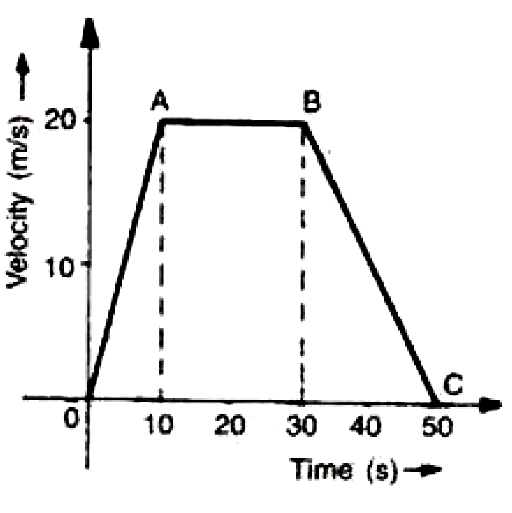
The graph shows how the velocity of a scooter varies with time in 50 s.
Work out: Deceleration